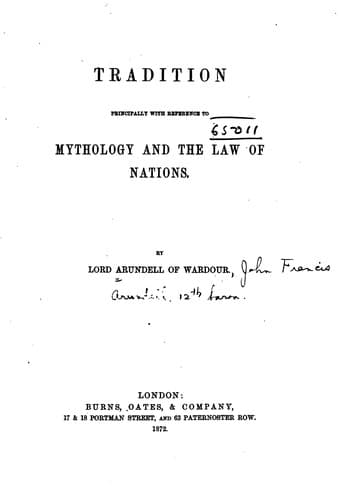
Tradition, Principally with Reference to Mythology and the Law of NationsArundell of Wardour, John Francis Arundell, Baron
Philosophy
Tradition, Principally with Reference to Mythology and the Law of Nations
Arundell of Wardour, John Francis Arundell, Baron
International law; Macdonell, George, 1780-1870; Mythology; Natural law; Tradition (Theology)
[141] What is still more remarkable, the same tradition is found
in the "Popol Vul" (Mexican traditions), and as it is there
given, fits in still more exactly with the solution I have
suggested. It is there said that the _first race_ of men
were created "_out the earth_," the third out "_of a tree_
called Tzité."[B] _If_ the "Popol Vul" came under Christian
or European influences in the 17th century, it would have
been more likely to have been brought into harmony with the
Bible, rather than with either Homer, Hesiod, or the Edda.
Let us pursue the myth a little further. Mr W. K. Kelly,
"Indo-Europ. Tradition and Folklore" (_vide_ Max Müller, ii.
197) says, "This healing virtue, which the mistletoe shares
with the _ash_, is a long descended tradition, for the Kushtha
... a healing plant, was one that grew beneath the _heavenly
Asvattha_," which is elsewhere called "the imperishable
Asvattha or Peepul (_Ficus religiosus_), out of which the
immortals shaped the heaven and the earth," which legend Mr
Kelly further traces in the German Yggdrasil (although Mr Max
Müller from his own point of view dissents); at the foot of
which tree (p. 207) "lies the serpent Nidhöggr, and gnaws its
roots." Neither Mr Max Müller nor Mr Kelly discuss the point
with reference to the view suggested above.
[B] _Tiki_ was the great progenitor among New
Zealanders.--_Shortland_, p. 56.
[142] Gen. i. 1, "In the beginning God created heaven and earth.
2. And the earth was void and empty, and _darkness was_ upon
the face _of the deep_; and the spirit of God moved over the
waters. 5. And He called the light day and the darkness night;
and there was _evening_ and morning one day."
In addition to the instances adduced by Gainet, it will
be remembered that the Jewish sabbath was from evening to
evening, and with us the astronomical day commences at noon,
and the commencement and termination of the civil day at mean
midnight.
In the _second_ [Chinese] dynasty the day commenced at
mid-day. Wei-Wang, the founder of the _third_ dynasty, fixed
it at midnight." (Bunsen's "Egypt," vol. iii. p. 390.)
In the Phoenician cosmogony "the beginning of all was a dark
and stormy atmosphere," "thick, unfathomable black chaos."
(_Vide_ Bunsen's "Egypt," iv. 176.)
The New Zealanders have preserved the tradition with still
greater distinctness. "In the _beginning of time_ was Te Po
(the night or darkness). In the generations that followed
Te Po came Te Ao (the light)" &c., &c. (_Vide_ Shortland's
"Traditions of the New Zealanders," p. 55.)
Public-domain text, read in full here on John Shaqi.
Reviews
Reviews
No reviews yet
Be the first to share your thoughts on this work.
Elsewhere in the archive
Join the Discussion
Join the discussion
Sign in to leave a comment or review.
Sign InorCreate an account