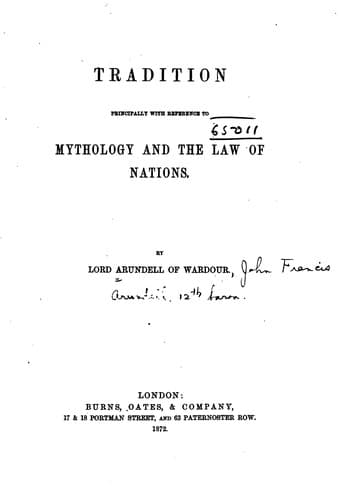
Tradition, Principally with Reference to Mythology and the Law of NationsArundell of Wardour, John Francis Arundell, Baron
Philosophy
Tradition, Principally with Reference to Mythology and the Law of Nations
Arundell of Wardour, John Francis Arundell, Baron
International law; Macdonell, George, 1780-1870; Mythology; Natural law; Tradition (Theology)
_Vide_ Gladstone, "Homer," ii. 155; Cox, "Mythology of Aryan
Nations," i. 15, on the relation of Phoibos to Leto. "This is
precisely the relation in which the _mythical night_ stood to
the day which was to be born of _her_."
_Vide_ on this point Wilkinson's "Ancient Egyptians" (I.
chap. xiii.) "The Mygale," says Champollion, "received
divine honours by the Egyptians, because it is blind, and
_darkness is more ancient than light_." The Arabs have the
expression "_night and day_" (_vide_ Wilkinson). Aristotle
says "The theologians consider all things to have been born of
night." The Orphean fragments call "night the Genesis of all
things.... The Anglo-Saxons also, like the Eastern nations,
began their computations of time from night, and the years
from that day corresponding with our Christmas, which they
called "Mother Night," and the Otaheitans refer the existence
of their principal deities to a state of darkness, which they
consider the origin of all things." (_Vide_ Gen. i. 2, 3;
_id._ p. 273-4.)
I think Mr Max Müller will at least recognise them as spots on the disk
of his solar theory, and which must ever remain obscure to those who
refuse the light of Scripture and tradition.
APPENDIX TO CHAPTER VIII.
"OEDIPUS, PERSEUS."
Here again, the explanation of Mr Max Müller, "si non vrai est
vraisemblable," and yet I cannot help seeing that the legends of
Perseus and [OE]dipus may just as well be supposed to embody primitive
tradition. Let us read the histories of OEdipus and Perseus in the
light of the tradition concerning Lamech (Gen. iv. 23, 24). "And
Lamech said to his wives, Adah and Zillah ... I have slain a man to
the wounding of myself, and a stripling to my own bruising. Sevenfold
vengeance shall be taken for Cain, but for Lamech seventy times
sevenfold." The note to the Douay edition says--"It is the tradition
of the Hebrews that Lamech, in hunting, slew Cain, mistaking him for
a wild beast, and that having discovered what he had done, he beat so
unmercifully the youth by whom he was led into that mistake that he
died of the blows." OEdipus was the son of Laius, who had supplanted
his brother. OEdipus was exposed to destruction as soon as born,
because his father had been warned that he must perish by the hand of
his son,--but was rescued and brought up by shepherds. Hearing from
the oracle of Delphi (the tradition is of course localised), that if
he returned home he must necessarily be the murderer of his father, he
avoided the house of Polybus, the only home he knew of, and travelled
towards Phocis (from west to east by the by). (Comp. with _infra_, p.
194.) He met Laius, his father, in a narrow road. Laius haughtily
ordered OEdipus to make way for him, which provoked an encounter,
in which Laius and his armour-bearer were slain. Other circumstances,
Public-domain text, read in full here on John Shaqi.
Reviews
Reviews
No reviews yet
Be the first to share your thoughts on this work.
Elsewhere in the archive
Join the Discussion
Join the discussion
Sign in to leave a comment or review.
Sign InorCreate an account