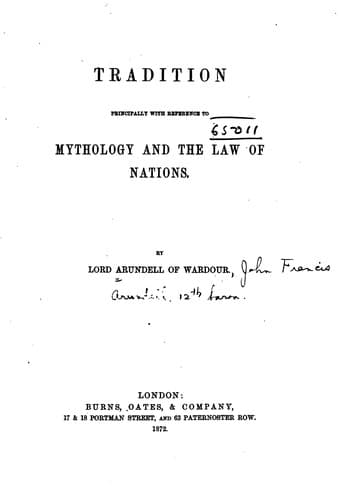
Tradition, Principally with Reference to Mythology and the Law of NationsArundell of Wardour, John Francis Arundell, Baron
Philosophy
Tradition, Principally with Reference to Mythology and the Law of Nations
Arundell of Wardour, John Francis Arundell, Baron
International law; Macdonell, George, 1780-1870; Mythology; Natural law; Tradition (Theology)
either separate traditions of the same event, or distinct legends, are
no doubt mixed up in the narration, but still four facts remain as a
residuum available for the comparison.
OEdipus was the son, as Lamech was the grandson, of one who
supplanted his brother, both kill their respective progenitors, and
in the _casual_ encounter in which in both instances the tragedy
occurred, _two_ persons were slain. In this there is a fair outline of
resemblance.
In the legend of Perseus, certainly the legend is more indistinct,
et, in one point, that he inadvertently killed his _grandfather_, the
coincidence is perfect. And it must be borne in mind that it is not
a question of absolute but of comparative resemblance--in fact, a
choice between a mythical or an historical, an astral or a scriptural
solution, and when you come to degrees of relationship, the astral or
solar explanation becomes more attenuated at each remove,--"the father
of the sun" may be metaphorically intelligible, but the grandfather of
the sun!
I see further trace of the tradition of Lamech in the Phrygian legend
of Adrastus, somewhat confused in the tradition of Cain, and in
some points reversed. Adrastus, the son of the Phrygian king, had
_inadvertently killed_ his brother, and was in consequence expelled by
his father and deprived of everything. Whilst an exile at the court
of Croesus, he was sent out with Prince Atys as guardian to deliver
the country from a wild boar. Adrastus had the misfortune to kill
Prince Atys while aiming at the wild beast. Croesus pardoned the
unfortunate man, as he saw in this accident the will of the gods, and
_the fulfilment of a prophecy_, but Adrastus killed himself on the tomb
of Atys (Herod. i. 35; Smith, "Myth. Dict.")
Now let us take up the proof at another point. Will any one refuse
to see in the following tale from the "Gesta Romanorum,"[143] at
least a mediæval corruption of the legend of OEdipus:--"A certain
soldier, called Julian, unwittingly killed his parents. For being
of noble blood, and addicted as a youth frequently is to the sports
of the field, a stag which he hotly pursued suddenly turned round
and addressed him--'Thou who pursuest me thus fiercely shall be the
destruction of thy parents.' These words greatly alarmed Julian....
Leaving, therefore, his amusement, he went privately into a distant
country ... where he marries. It chances that his parents come into
that country, and in his absence were received kindly by his wife, who,
'in consideration of the love she bore her husband, put them into her
own bed, and commanded another to be prepared elsewhere for herself.'
In the meantime, Julian returning abruptly home and discovering
strangers in his bed, in a fit of passion slays them. When he discovers
the parricidal crime he exclaims--'This accursed hand has murdered my
parents and fulfilled the horrible prediction which I have struggled to
avoid.'"
[143] "Gesta Romanorum," tale xviii. Swan. Rivingtons 1824.
Public-domain text, read in full here on John Shaqi.
Reviews
Reviews
No reviews yet
Be the first to share your thoughts on this work.
Elsewhere in the archive
Join the Discussion
Join the discussion
Sign in to leave a comment or review.
Sign InorCreate an account