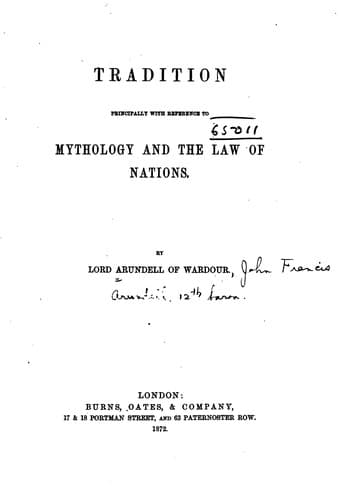
Tradition, Principally with Reference to Mythology and the Law of NationsArundell of Wardour, John Francis Arundell, Baron
Philosophy
Tradition, Principally with Reference to Mythology and the Law of Nations
Arundell of Wardour, John Francis Arundell, Baron
International law; Macdonell, George, 1780-1870; Mythology; Natural law; Tradition (Theology)
Now, I submit that this is not a greater distortion of the classical
stories of OEdipus, Adrastus, &c., than are the classical legends of
the biblical traditions of Cain and Lamech.
For further trace read Bunsen, iv. 235, also, 253, 254. Mr Cox
("Mythology of Aryan Nations") says:--"_The names Theseus_, _Perseus_,
_Oidipous, had all been mere epithets_ of one and the same being; but
when they ceased to be mere appellatives, these creations of mythical
speech were regarded not only as different persons, but as beings in
no way connected with each other.... Nay, the legends inter-change
the method by which the parents seek the death of their children; for
there were tales which narrated that Oidipous was shut up in an ark
which was washed ashore at Sikyon," p. 80. Sicyon was the oldest Greek
city. Compare p. 157 of this ch., and ch. on Deluge. This was merely
the traditional record that the tradition was preserved in the Ark, and
subsequently emanated from Sicyon.
II. PROMETHEUS AND HERCULES OR HERAKLES.
I have elsewhere (p. 202) alluded to the confusion of Prometheus, as
the creator of man, with Prometheus, the first man created. But the
most curious instance of reduplication is the further confusion of what
I may call the human Prometheus, with his deliverer Hercules,--Hercules
and Prometheus both in different ways embodying traditions of Adam!
Prometheus is the Adam[144] of Paradise and the Fall, Hercules is Adam
the outcast from Paradise, with his skin and club sent forth on his
long labours and marches through the world. But how can Hercules, who
frees Prometheus from the rock, be the same as Prometheus who is bound
to the rock? If, however, we are entitled to hope that Adam in the
labour of his long exile worked off the sentence and expiated the guilt
on account of which Adam, the culprit, was sentenced, may we not accept
this as an adequate explanation? Is it a forced figure that he should
be said to unbind him from the rock, to drive off the vulture which
preys upon him, and thus finally liberate him?
[144] On this point, that Prometheus is Adam, _vide_ M. Nicolas'
"Etudes Philos. sur le Christ.," 1. ii. ch. v. 30 (19th edit.)
This disjunction of Adam and separate personification in the two
periods of his life, _before_ and _after_ the Fall, will accord well
enough with the addition in some legends of a brother Epimetheus, and
I submit that this explanation is as good as that (_vide_ Smith's
"Myth. Dict.") which regards the legend as purely allegorical,
and _Pro_metheus and _Epi_metheus as signifying "forethought" and
"afterthought."
Public-domain text, read in full here on John Shaqi.
Reviews
Reviews
No reviews yet
Be the first to share your thoughts on this work.
Elsewhere in the archive
Join the Discussion
Join the discussion
Sign in to leave a comment or review.
Sign InorCreate an account