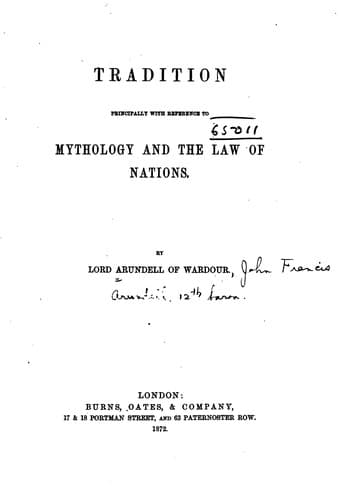
Tradition, Principally with Reference to Mythology and the Law of NationsArundell of Wardour, John Francis Arundell, Baron
Philosophy
Tradition, Principally with Reference to Mythology and the Law of Nations
Arundell of Wardour, John Francis Arundell, Baron
International law; Macdonell, George, 1780-1870; Mythology; Natural law; Tradition (Theology)
The travels of Hercules, it must be confessed, as traditionally
recorded, are somewhat eccentric. But are they explicable on any solar
theory? He begins by travelling from _west_ to east; he then proceeds
_south_, and although he traverses Africa westward, he diverges
abruptly to the _north_, from which he proceeds south, and ends as
he began by travelling from _west_ to east. All this, however, is
perfectly explicable if we are prepared to admit Bryant's ("Mythology,"
ii. 70) historical surmises, and to go along with him so far as to
believe that the tradition was mainly preserved through Cuthite or
_Chus_ite channels. We can, then, see a probability in the conjecture
that the descendants of Chus, in preserving the tradition of the
travels of Hercules (Herakles), superadded or substituted the scenes
and incidents of their own wanderings, after they had settled down in
the place of their final location.
CHAPTER IX.
_ASSYRIAN MYTHOLOGY._
"But surely there is nothing improbable in the supposition, that
in the poems of Homer such vestiges may be found. Every recorded
form of society bears some traces of those by which it has been
preceded, and in that highly primitive form, which Homer has
been the instrument of embalming for all posterity, the law of
general reason obliges us to search for elements and vestiges more
primitive still.... The general proposition that we may expect
to find the relics of scriptural traditions in the heroic age of
Greece, though it leads, if proved, to important practical results,
is independent even of a belief in those traditions, as they stand
in the scheme of revealed truth. They must be admitted to have
been facts on earth, even by those who would deny them to have
been facts of heavenly origin, in the shape in which Christendom
receives them; and the question immediately before us is one of
pure historical probability. The descent of mankind from a single
pair, the lapse of that pair from original righteousness, are apart
from and ulterior to it. We have traced the Greek nation to a
source, and along a path of migration which must in all likelihood
have placed its ancestry, at some point or points, in close local
relations with the scenes of the earliest Mosaic records: the
retentiveness of that people equalled its receptiveness, and its
close and fond association with the past, made it prone indeed to
incorporate novel matter into its religion, but prone also to keep
it there after its incorporation.
Public-domain text, read in full here on John Shaqi.
Reviews
Reviews
No reviews yet
Be the first to share your thoughts on this work.
Elsewhere in the archive
Join the Discussion
Join the discussion
Sign in to leave a comment or review.
Sign InorCreate an account