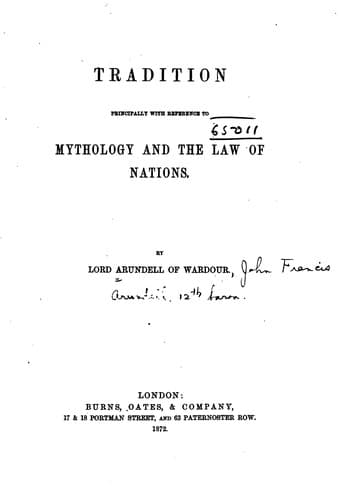
Tradition, Principally with Reference to Mythology and the Law of NationsArundell of Wardour, John Francis Arundell, Baron
Philosophy
Tradition, Principally with Reference to Mythology and the Law of Nations
Arundell of Wardour, John Francis Arundell, Baron
International law; Macdonell, George, 1780-1870; Mythology; Natural law; Tradition (Theology)
"If such traditions existed, and if the laws which guide historical
inquiry require or lead us to suppose that the forefathers of
the Greeks must have lived within their circle, then the burden
of proof must lie not so properly with those who assert that
the traces of them are to be found in the earliest, that is,
the Homeric form of the Greek mythology, as with those who deny
it. What became of those old traditions? They must have decayed
and disappeared, not by a sudden process, but by a gradual
accumulation of the corrupt accretions, in which at length they
were so completely interred as to be invisible and inaccessible.
Some period, therefore, there must have been at which they would
remain clearly perceptible, though in conjunction with much corrupt
matter. Such a period might be made the subject of record, and if
such there were, we might naturally expect to find it in the oldest
known work of the ancient literature.
"If the poems of Homer do, however, contain a picture, even though
a defaced picture, of the primeval religious traditions, it is
obvious that they afford a most valuable collateral support to the
credit of the Holy Scripture, considered as a document of history.
Still we must not allow the desire of gaining this advantage
to bias the mind in an inquiry, which can only be of value if
it is conducted according to the strictest rules of rational
criticism."--_Gladstone on Tradition in "Homer and the Homeric
Age_," vol. ii. sect. i.
Having laid, as I think, in what has been premised in the last chapter,
grounds for a presumption that primitive traditions may be shrouded in
the ancient mythology, I proceed to seek traditions of the patriarch
Noah among the inscriptions and monuments of the Chaldæans; for
then we shall find ourselves in a period when the results of modern
archæological science are in contact with the events and incidents of
primitive patriarchal life recorded in Scripture; and, in seeking them
where we shall best find them, in the able and discriminating pages
of Rawlinson, we shall at least feel that we are treading on safe and
solid ground.
The deities in the Chaldæan Pantheon are thus enumerated by Professor
Rawlinson--
Public-domain text, read in full here on John Shaqi.
Reviews
Reviews
No reviews yet
Be the first to share your thoughts on this work.
Elsewhere in the archive
Join the Discussion
Join the discussion
Sign in to leave a comment or review.
Sign InorCreate an account