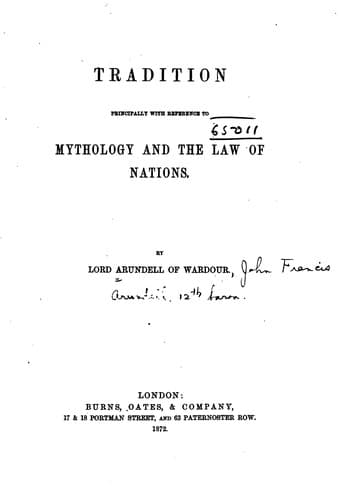
Tradition, Principally with Reference to Mythology and the Law of NationsArundell of Wardour, John Francis Arundell, Baron
Philosophy
Tradition, Principally with Reference to Mythology and the Law of Nations
Arundell of Wardour, John Francis Arundell, Baron
International law; Macdonell, George, 1780-1870; Mythology; Natural law; Tradition (Theology)
"The grouping of the principal Chaldæan deities is as follows:--At
the head of the Pantheon stands a god Il or Ra, of whom little
is known. Next to him is a triad, Ana, Bil or Belus, and Hea or
Hoa, who correspond closely to the classical Pluto, Jupiter, and
Neptune. Each of these is accompanied by a female principle or
wife.... Then follows a further triad, consisting of Sin or Hurki
the moon-god, San or Sanci the sun, and Vul (or Yem, or Ao, or
In, or Ina, according to various readings of the hieroglyphics)
the god of the atmosphere (again accompanied by female powers or
wives).... Next in order to them we find a group of five minor
deities, the representatives of the five planets, Nin or Ninip
(Saturn), Merodach (Jupiter), Nergal (Mars), Ishtar (Venus), and
Nebo (Mercury). [The bracket indications are Rawlinson's.]...
These principal deities do not appear to have been connected like
the Egyptian and classical divinities into a single genealogical
scheme" (i. 141).
In a note at p. 142 it is said, "These schemes themselves were probably
not genealogical at first ... but after a while given to separate
and independent deities, recognised in different places by distinct
communities, or even by distinct races" (_vide_ Bunsen's "Egypt," iv.
66; English Tran.)
Now to this opinion I venture unreservedly to adhere, and I connect it
with the statement (_id._ i. 72), that "Chaldæa in the earliest times
to which we can go back, seems to have been inhabited by four principal
tribes. The early kings are continually represented in the monuments
as sovereigns over the Kiprat-arbat, or 'Four Races' (_vide supra_, p.
30). These 'Four Races' are sometimes called the Arba Lisun or 'Four
Tongues,' whence we may conclude that they were distinguished from one
another, among other differences, by a variety in their forms of speech
... an examination of the written remains has furnished reasons for
believing that the differences were great and marked; the languages,
in fact, belonging to the four great varieties of human speech, the
Hamitic, Semitic, Aryan, and Turanian." Compare pp. 39, 40.
If it is allowed that there may have been mythological systems
corresponding to these divers nationalities, we may fairly conclude
that the deities above enumerated may not necessarily have been
different deities, but the same deities viewed in different lights, or
included in duplicate in the way of incorporation, or in recognition
of subordinate nationalities. If, therefore, I find the representation
of Noah in any one of these deities, is there not a _prima facie_
probability that I shall find the reduplication of him in others? I
consider, at least, that I shall have warrant for thus collecting the
scattered traditions concerning the patriarch who stands at the head of
the second propagation of our race.
But first as to the god Il or Ra--
IL OR RA.
Public-domain text, read in full here on John Shaqi.
Reviews
Reviews
No reviews yet
Be the first to share your thoughts on this work.
Elsewhere in the archive
Join the Discussion
Join the discussion
Sign in to leave a comment or review.
Sign InorCreate an account