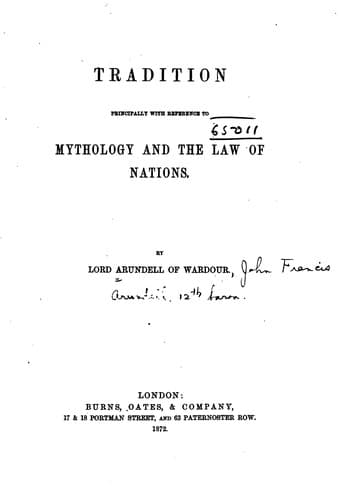
Tradition, Principally with Reference to Mythology and the Law of NationsArundell of Wardour, John Francis Arundell, Baron
Philosophy
Tradition, Principally with Reference to Mythology and the Law of Nations
Arundell of Wardour, John Francis Arundell, Baron
International law; Macdonell, George, 1780-1870; Mythology; Natural law; Tradition (Theology)
The form _Ra_ represents, probably, the native Chaldæan name of
this deity, while _Il_ is the Semitic equivalent. _Il_, of course,
is but a variant of _El_, the root of the well-known biblical
_Elohim_, as well as of the Arabic Allah. It is this name which
Diodorus represents under the form of _Elus_, and Sanchoniathon, or
rather Philo Biblius, under that of Elus, or _Ilus_. The meaning of
the word is simply "God," or perhaps "The God" emphatically. _Ra_,
the Cushite equivalent, must be considered to have had the same
force originally, though in Egypt it received a special application
to the sun, and became the proper name of that particular deity.
The word is lost in the modern Ethiopic. It formed an element
in the native name of Babylon, which was _Ka-ra_, the Cushite
equivalent of the Semitic _Bab-il_, an expression signifying "the
gate of God."
Ra is a god with few peculiar attributes. He is a sort of fount
and origin of deity, too remote from man to be much worshipped, or
to excite any warm interest. There is no evidence of his having
had any temple in Chaldæa during the early times. A belief in his
existence is implied rather than expressed in inscriptions of the
primitive kings, where the Moon-god is said to be "brother's son
of Ana, and eldest son of Bil or Belus." We gather from this, that
Bel and Ana were considered to have a common father, and later
documents sufficiently indicate that that common father was Il or
Ra."--_Rawlinson_, i. p. 143.
If in the Il or Ra of the Chaldæans the primitive monotheism is not
revealed, I do not see how it can be discerned in the Zeus of the
Greeks. We have the same god in the same relation in the Scandinavian,
or at any rate in the Lapland mythology. Leems ("Account of Danish
Lapland," Pinkerton, i. 458) says--"Of the Gods inhabiting the starry
mansions the _greatest is Radien_, yet it is uncertain whether he is
over every part of the sidereal sky, or whether he governs only some
part of it. Be this as it may, I shall be bold to affirm that the
Laplanders never comprehended, under the name of this false god, the
true God; _which is obvious from this_, that some have not scrupled to
put the image or likeness of the true God by the side of their Radien,
on Runic boxes."[145] If, however, of their gods "the greatest was
Radien," they would not have placed the true God by his side until
they had become acquainted with the true God, or until they had come
to commingle Christianity and Paganism; but then would they not have
placed "Ra" by the side of the true God as His counterpart? I am
assuming that "Radien" means simply the god Ra, as I suppose Mr Max
Müller would recognise "dien" as cognate to "Dyaus" ... "Dieu."
Public-domain text, read in full here on John Shaqi.
Reviews
Reviews
No reviews yet
Be the first to share your thoughts on this work.
Elsewhere in the archive
Join the Discussion
Join the discussion
Sign in to leave a comment or review.
Sign InorCreate an account