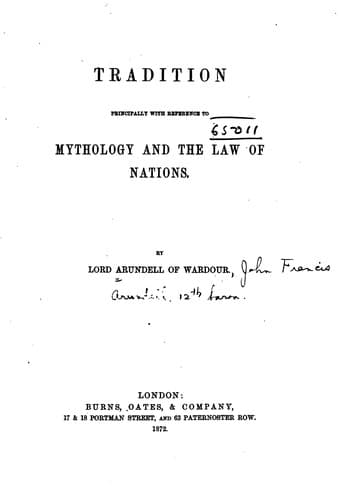
Tradition, Principally with Reference to Mythology and the Law of NationsArundell of Wardour, John Francis Arundell, Baron
Philosophy
Tradition, Principally with Reference to Mythology and the Law of Nations
Arundell of Wardour, John Francis Arundell, Baron
International law; Macdonell, George, 1780-1870; Mythology; Natural law; Tradition (Theology)
[145] In like manner, the Peruvians recognised "Pachacamac" (_vide
infra_, p. 304), in the description which the Spaniards
gave of the true God; and in so far as they had retained the
monotheistic belief, this was true. Garcilasso de la Vega, a
most competent witness who testifies to this, adds--"If any
one shall now ask me, who am a Catholic Christian Indian, by
the infinite mercy, what name was given to God in my language,
I should say Pachacamac."--Hakluyt Society, ed. of Garcil. de
la Vega, i. 107.
Yet it has been opposed, _in limine_, to M. L'Abbe Gainet's valuable
chapter on the "Monotheisme des Peuples primitifs," "that he does not
meet the specific assertions of historians such as Rawlinson, who finds
idolatry prevalent among the Chaldæans on their first appearance on the
stage of history."
I must submit, however, that although the discovery of idolatry at this
early period may appear to disturb the particular theory, yet on closer
examination it will be found to sustain L'Abbe Gainet's argument, on
the whole, by sustaining the truth of tradition upon which his main
argument reposes; for the idolatry which we find is intimately bound
up with the worship of Belus, identified with Nimrod, whose rebellion
against the Lord has always been in tradition, and is according to
the more accepted interpretation of the sacred text. The discovery of
idolatry, therefore, under the particular circumstances, is exactly
what we should expect, and affords a remarkable confirmation of the
fidelity of tradition.
Moreover, there are Chaldæans and Chaldæans, as we have just seen in
Rawlinson (_sup._ p. 184), and as will be made more evident in the
following passage from Gainet's "Monotheisme," &c.
"It is sufficiently agreed, says Lebatteux (Mem. Acad. t. xxvii. p.
172), that the Babylonians recognised a supreme being, the Father
and Lord of all (Diod. Sic. l. ii.) St Justin Cohortat. ad gent.
Eusebi. Prep. Evan., l. iii. Porphyry (Life of Pythagoras) cites an
oracle of Zoroaster, in which the Chaldæans are coupled in encomium
with the Hebrews for the sanctity of the worship which they paid to
the Eternal King. These are the words of the oracles--The Chaldeans
alone with the Hebrews have wisdom for their share, rendering a
pure worship to God, who is the Eternal King."--_Gainet_, iii. 408.
The pure monotheism here alluded to may have been preserved in Chaldæan
families of Semitic origin, but the extract I have just given from
Rawlinson seems to prove that the knowledge was preserved also, dimly
and obscurely, among the predominant Chaldæans of Hamitic descent. This
will be more apparent from the monotheistic epithets attached to the
three next deities.
ANA.
Public-domain text, read in full here on John Shaqi.
Reviews
Reviews
No reviews yet
Be the first to share your thoughts on this work.
Elsewhere in the archive
Join the Discussion
Join the discussion
Sign in to leave a comment or review.
Sign InorCreate an account