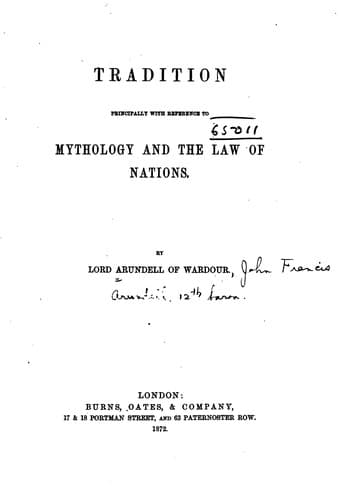
Tradition, Principally with Reference to Mythology and the Law of NationsArundell of Wardour, John Francis Arundell, Baron
Philosophy
Tradition, Principally with Reference to Mythology and the Law of Nations
Arundell of Wardour, John Francis Arundell, Baron
International law; Macdonell, George, 1780-1870; Mythology; Natural law; Tradition (Theology)
"Ana is the head of the first triad which follows immediately after
the obscure god Ra." "Ana, like Il and Ra, is thought to have been a
word originally signifying God in the highest sense." "He corresponds
in many respects to the classical Hades, who, like him, heads[146] the
triad to which he belongs." In so far he is undistinguishable from
Il or Ra, and may only transmit the monotheistic tradition through
a different channel. But Ana has human epithets applied to him very
suggestive of hero-worship. "His epithets are chiefly such as mark
priority and antiquity." "He is the Old Ana," "the original chief,"
"the father of the gods" [_inter alia_, of Bil Nipru, _i.e._ Nimrod].
He is also called--which imports another association of ideas--"the
lord of spirits and demons," "the king of the lower world,"[147] "the
lord of darkness or death," "the ruler of the far-off city."
[146] "This is not a mere arbitrary supposition, for it is expressly
said in Holy Writ, that the first man, ordained to be 'the
father of the whole earth' (as he is then called), became,
on his reconciliation with his Maker, the wisest of all men,
and, according to tradition, the greatest of prophets, who in
his far-reaching ken, _foresaw the destinies of all mankind_
in all successive ages down to the end of the world. All this
must be taken in a strict historical sense, for the moral
interpretation we abandon to others. The pre-eminence of the
Sethites chosen by God, and entirely devoted to His service,
must be received as an undoubted historical fact, to which
we find many pointed allusions even in the traditions of the
other Asiatic nations. Nay, the hostility between the Sethites
and Cainites, and the mutual relations of these two races,
form the chief clue to the history of the primitive world, and
even of many particular nations of antiquity."--_Fred. Von
Schlegel's "Philosophy of Hist.," Robertson's trans._, p. 152.
[147] Compare these epithets, and what was said above, of
resemblance "to classical Hades," with the following verses
from the "Oracula Sybillina," lib. i. 80--
"Orcus eos cepit græco qui nomine dictus
Est _Ades_, quod primus eo descenderit _Adam_,
Expertus mortis legem," &c.
Public-domain text, read in full here on John Shaqi.
Reviews
Reviews
No reviews yet
Be the first to share your thoughts on this work.
Elsewhere in the archive
Join the Discussion
Join the discussion
Sign in to leave a comment or review.
Sign InorCreate an account