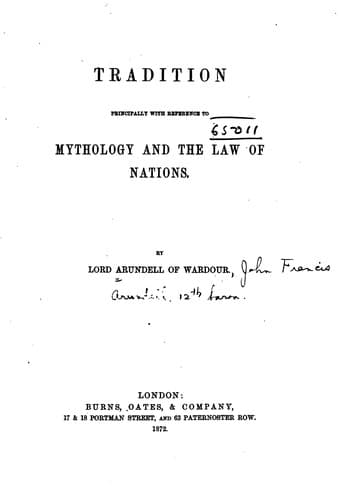
Tradition, Principally with Reference to Mythology and the Law of NationsArundell of Wardour, John Francis Arundell, Baron
Philosophy
Tradition, Principally with Reference to Mythology and the Law of Nations
Arundell of Wardour, John Francis Arundell, Baron
International law; Macdonell, George, 1780-1870; Mythology; Natural law; Tradition (Theology)
Setting aside such titles as belong exclusively to the Deity, but
assuming hero-worship--supposing man deified--who more appropriately
placed in these primitive times at the head of the list, than their
original progenitor Adam.[148] To whom would these titles, "the old
Ana,"[149] "the original chief," "the lord of darkness and death," he
who introduced death into the world, more exactly apply? Rawlinson
also says--"His position is well marked by Damascius, who gives the
three gods Anus, Illinus, and Aüs, as _next in succession to the
primeval pair_, Assorus and Missara," i. 145. Now, it will not be
contested, I think, that Assorus is the same as Alorus, the first of
the ten antediluvian (deluge of Xisuthrus) Assyrian kings enumerated
by Berosus, and which correspond to the ten antediluvian patriarchs.
Consequently Assorus = Alorus = Adam.[150]
[148] Osiris also is "the judge of the soul, or the god of the world
of spirits." "Osiris is never represented in an animal form,
but is called the Bull" (_infra_ pp. 203, 204), _vide_
Bunsen's "Egypt," iv. 332. Bunsen's own view is, that "the
history of Osiris is the history of the cycle of the year,
of the sun dying away and resuscitating himself again." Mr
Palmer ("Egyptian Chronicles," i. p. 3) says--(and I think
it as well that I should state that I had come to an almost
identical conclusion, and had written this and the following
chapter before I became acquainted with Mr Palmer's profound
and yet still neglected work, _vide_ ch. vi.)--"The first
human ('Osiris = Adam and Isis = Eve') having been thrown back
into pairs of anthropomorphous deities (p. 2), the original
Osiris and Isis, formed by the divine potter as parents of
all, disappear in name, and are represented by Seb and Nutpe,
while Osiris, Typhon, and Horus, the progeny of Seb and Nutpe,
answers rather to Cain, Abel, and Seth, in the old world,
and to the three sons of Noah in the new.... From Osiris-Seb
(whether he be viewed as Adam or Noah) are derived downwards
all the successive generations of Egyptian, gods and demigods,
patriarchs, kings, and other men" [and for a parallel
exposition of the Phoenician myth, _vide_ Palmer, p. 53 and
seq., "each dynast in turn, in the early generations, being
identifiable at once with Seb and Osiris, as father of those
following, with Osiris again by sharing the same mortality,
and with Horus as renewing his father's life and being the
hope of the coming world. _So each ancestor in turn went_, it
was said, _to the original Osiris as patriarch of the dead_,
and to his intermediate Osirified fathers, and was himself
Osirified like them, all making one collective Osiris." [I
have not space to discuss the question at what stage the
Public-domain text, read in full here on John Shaqi.
Reviews
Reviews
No reviews yet
Be the first to share your thoughts on this work.
Elsewhere in the archive
Join the Discussion
Join the discussion
Sign in to leave a comment or review.
Sign InorCreate an account