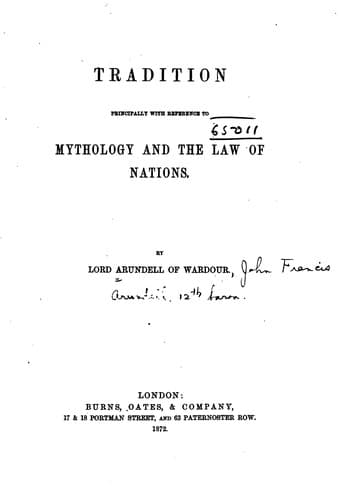
Tradition, Principally with Reference to Mythology and the Law of NationsArundell of Wardour, John Francis Arundell, Baron
Philosophy
Tradition, Principally with Reference to Mythology and the Law of Nations
Arundell of Wardour, John Francis Arundell, Baron
International law; Macdonell, George, 1780-1870; Mythology; Natural law; Tradition (Theology)
mythology became pantheistic.] "Waiting for that reunion and
restoration which was to come through successive generations
by the great expected Horus, who was to take up into himself
the old, and to be himself the new Osiris."
[149] In a note to Cardinal Wiseman's "Science and Revealed
Religion" on Conformity between Semitic and Indo-Europ.
grammatical forms, it will be seen that _Ana_ in Chaldaic is
the pronoun of the first person singular, and corresponds with
the revealed appellation of the Deity, "I Am who Am" (Exod.
iii. 14) = the [Greek: tò Egô].
[150] Max Müller, Chips i. 153, refers to Dr Windischmann's
("Zoroastrian Studies") discovery that there are ten
generations between Adam and Noah, as there are ten
generations in the Zendavesta between Yima (Adam) and
Thrâstouna (Noah), and without controverting the point. Mr
Palmer ("Egypt. Chron.," i. 45) says--"And though the fancy
of making the ten kings to begin only after 1058 years, and
to be not all named from the same city, seems to distinguish
them from Adam and the nine patriarchs his descendants, still
Xisuthrus, the tenth, being clearly identified with Noah, by
the flood and the ark, the very number ten, and the relation
of the succession in which they stand one to the other, show
that Alorus, the first of them, is no other than Adam."
Here, then, we have a reduplication, or else what I have above
referred to, the tendency to place the head of the dynasty at the
top of the list superior to gods and men. In any case, granting
this juxtaposition, would there not have been the proximate risk
and probability of the two running into one another and becoming
confounded, on the supposition that Ana and Alorus were not originally
identical?
This will become more evident when we have considered the next in the
triad--
BIL OR ENU.
But the evidence, though it will more clearly establish the fact of
hero-worship, will perhaps raise a doubt whether we have rightly
regarded Adam as the object of hero-worship in Ana, a point which we
will then consider.
Rawlinson says of this god--"He is the Illinus (Il-Enu) of Damascius."
"His name, which seems to mean merely lord" (again the primitive
monotheistic appellation) "is usually followed by a qualificative
adjunct possessing great interest. It is proposed to read this term as
Nipru, or in the feminine Niprut, a word which cannot fail to recall
the scriptural Nimrod, who is in the Septuagint Nebroth. The term
_nipru_ seems to be formed from the root _napar_, which is the Syriac
"to pursue," to "make to flee," and which has in Assyrian nearly the
same meaning. Thus Bil Nipru would be aptly translated as "the hunter
lord" or the "god presiding over the chase," while at the same time
it might combine the meaning of the "conquering lord" or "the great
conqueror."
Public-domain text, read in full here on John Shaqi.
Reviews
Reviews
No reviews yet
Be the first to share your thoughts on this work.
Elsewhere in the archive
Join the Discussion
Join the discussion
Sign in to leave a comment or review.
Sign InorCreate an account