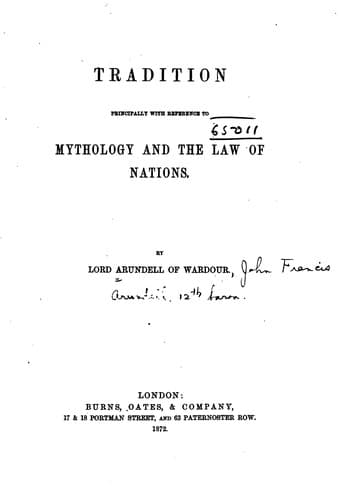
Tradition, Principally with Reference to Mythology and the Law of NationsArundell of Wardour, John Francis Arundell, Baron
Philosophy
Tradition, Principally with Reference to Mythology and the Law of Nations
Arundell of Wardour, John Francis Arundell, Baron
International law; Macdonell, George, 1780-1870; Mythology; Natural law; Tradition (Theology)
Here, at any rate, it must be admitted that "we have, in this instance,
an admixture of hero-worship in the Chaldæan religion" (Rawlinson, i.
148). But if in one instance what _à priori_ reason is there that it
should not be so in others? Let us, then, examine further. The name of
this deity, as Bel Nipru or Nimrod, has, I consider, been completely
traced in the pages of Rawlinson (to which I must refer my readers).
But what are we to say about the alternative name of Enu? And why,
although no great stress can be laid upon the location of a deity in
a genealogy or a system, yet why is Nimrod thus placed intermediate
between Adam and the third of the triad Hoa, whom, on grounds quite
irrespective of the similarity of name, I identify with Noah?[151]
[151] Gainet (i. 211) quotes as follows from "Ceremonies Relig." i.
vii.: "The Mandans pretend that the Deluge was caused by the
white men to destroy their ancestors. The whites caused the
waters to rise to such a height that the world was submerged.
Then _the first man, whom they regard as one of their
divinities, inspired mankind with the idea of constructing,
upon an eminence, a tower and fortress of wood_, and _promised
them that the water should not rise beyond this point_." Here
seems a very analogous confused tradition of Adam and Nimrod,
the Deluge and the Tower of Babel. Comp. with the distinct
testimony to the Mandan tradition, _infra_, ch. xi.
If Ana is Adam, and Hoa Noah, why should not Enu, in another point
of view, be Enoch? There is, I admit, an absence of direct evidence,
but I think I discover a link of connection in a note in Rawlinson
(i. p. 196). "Arab writers record a number of remarkable traditions,
in which he (Nimrod) plays a conspicuous part." "Yacut declares that
Nimrod attempted to mount to heaven on the wings of an eagle, and makes
Niffers (Calneh) the scene of this occurrence (Lex. Geograph. in voc.
Niffer). It is supposed that we have here an allusion to the building
of the Tower of Babel." But I cannot help regarding it as much more
certainly like an allusion to Enoch's disappearance from the earth. At
p. 187, Prof. Rawlinson notices the confusion of Xisuthrus with Enoch,
which proves that the tradition of Enoch was amongst them, and would
have been common also to the Hamitic Arabs.[152]
[152] I find that the Egyptians had the same confused tradition
respecting Menes, who stood to them in the same relation as
Nimrod to the Assyrians (_vide_ Bunsen's Egypt, ii. p. 65).
"The statement in Manetho's lists that Menes was torn to
pieces by a hippopotamus, is probably an exaggeration of an
early legend, that he was carried away by a hippopotamus, one
of the symbols of the god of the lower world. The great ruler
was snatched away from the earth, to distinguish him from
other mortals, just as Romulus was."
Public-domain text, read in full here on John Shaqi.
Reviews
Reviews
No reviews yet
Be the first to share your thoughts on this work.
Elsewhere in the archive
Join the Discussion
Join the discussion
Sign in to leave a comment or review.
Sign InorCreate an account