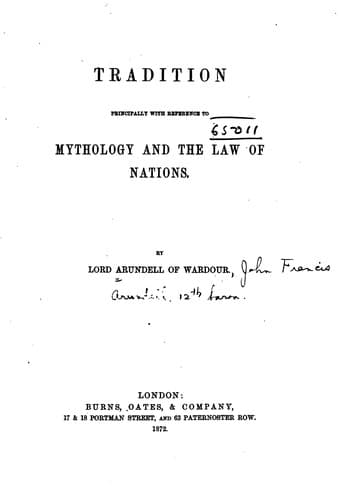
Tradition, Principally with Reference to Mythology and the Law of NationsArundell of Wardour, John Francis Arundell, Baron
Philosophy
Tradition, Principally with Reference to Mythology and the Law of Nations
Arundell of Wardour, John Francis Arundell, Baron
International law; Macdonell, George, 1780-1870; Mythology; Natural law; Tradition (Theology)
I will now return to my doubt as to Ana. For although I feel tolerably
certain that Ana in his human attributes represents one or other of the
antediluvian patriarchs, it may well be that he is only a reduplication
of Enu = Enoch. If we are to seek in the translation of Enoch the clue
to the origin of the deification of man, and its commencement in the
person of Nimrod (_vide supra_, p. 160), it is likely, in the legend
of the apotheosis of Nimrod, that all the analogies should have been
sought for in the striking historical event which was in tradition.
There is, moreover, the analogy of name with Annacus, Hannachus =
Enoch.[153] If he is Enoch, he naturally also falls into his place as
second to Assorus.
[153] "Etienne de Byzance dit qu'à 'Icone' ('de urbibus' voce
'Iconium') ville de Lycaonie près du Mont Taurus dans les
régions occupées par les habitants antediluviens regnait
Annacus dont la vie alla au-déla de trois cents ans. Tous
les habitants d'alentour demandèrent à un oracle jusqu'à
quelle époque se prolongerait sa vie. L'oracle répondit que
ce patriarche étant mort, tout le monde devait s'attendre à
périr. Les Phrygiens à cette ménace jetèrent les hauts cris,
d'où est venu le proverbe: 'Pleurer sous Annacus, ce que l'on
dit de ceux qui se livrent à des grands gémissements. Or le
Déluge étant survénu tous périrent.... Dans ces récits tout
est conformé à la Bible. Annacus a vécu trois cents ans avant
le Déluge. Il a averti ses concitoyens: il est entouré du même
respect que le patriarche Noë lui-même. Annacus parait venir
d'Enoch; tout announce une identité de personnages." (Gainet,
Hist. de L'Anc. et Nouv. Test. i. 94, 95.) The connection
between the death of Enoch and the destruction of mankind may
accord as well with the traditional belief in his reappearance
at the end of the world.
Compare the Grecian tradition of Inachus, son of Oceanus
(_vide_ Bryant, ii. 268), and with it, Hor., Od. 3, lib. ii.:
"Divesne, prisco et natus ab Inacho,
Nil interest, an pauper, et infimâ
De gente," &c.
I retain, however, my original opinion, that Ana is Adam (though
possibly with some confusion with Enoch), in addition to the arguments
already urged, upon the following grounds:--
Rawlinson mentions (i. 147) "Telane," or the "_Mound_ of Ana," distinct
from Kalneh or "Kalana." We know that there has been a constant
tradition that the bones of Adam were preserved in the ark, and this
name of the "Mound of Ana" may be connected with it. If so, it will
also account for Ana (Dis = Orcus) being the patron deity of Erech,
"the great city of the dead, the necropolis of Lower Babylonia"
(Rawlinson i. 146).
The son of Ana is Vul. If Vul could be identified with Vulcan, and
Vulcan with Tubalcain, it would go far to decide the point that Ana was
Adam.
Public-domain text, read in full here on John Shaqi.
Reviews
Reviews
No reviews yet
Be the first to share your thoughts on this work.
Elsewhere in the archive
Join the Discussion
Join the discussion
Sign in to leave a comment or review.
Sign InorCreate an account