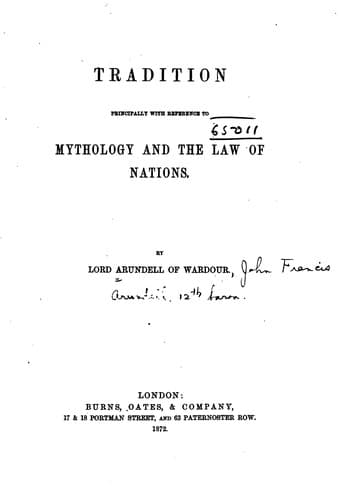
Tradition, Principally with Reference to Mythology and the Law of NationsArundell of Wardour, John Francis Arundell, Baron
Philosophy
Tradition, Principally with Reference to Mythology and the Law of Nations
Arundell of Wardour, John Francis Arundell, Baron
International law; Macdonell, George, 1780-1870; Mythology; Natural law; Tradition (Theology)
But in the matter of etymology, I do not know that we can advance
beyond the quaint phrase of old Sir Walter Raleigh in his "History
of the World," that "there is a certain likelihood of name between
Tubalcain and Vulcan." I rely more upon the wide-spread tradition of
Tubalcain in the legends of Dædalus, Vulcan, Weland, Galant, Wielant,
Wayland Smith, which approaches very nearly an identification. _Vide_
Wilson's "Archæologia of Scotland," p. 210. Compare the Phoenician
tradition, Bunsen's "Egypt," iv. 217, 219.
It is to be noted, however, that although Ana (_vide_ Rawlinson)
"like Adam had several sons, he had only two of any celebrity" (we
can suppose that Abel had died out of the Cainite tradition), "Vul
and another whose name represents 'darkness' or '_the west_,'" which
might well be the view of Seth from a Cainite point of view (and it is
traditional that the Cainite lore was preserved by Cham in the ark).
Now it is remarkable that the Scripture (Gen. iv.) expressly says that
Cain dwelt on the _east_ side of Eden.
I now come to
HEA OR HOA.
"The third god of the first triad was Hea or Hoa, the Ana of
Damascius. This appellation is perhaps best rendered into Greek
by the [Greek: Ôê] of Helladius, the name given to the mystic
animal, half man half fish, which came up from the Persian Gulf to
teach astronomy and letters to the first settlers on the Euphrates
and Tigris. It is perhaps contained in the word by which Berosus
designates this same creature--Oannes ([Greek: Ôánnês]), which
may be explained as Hoa-ana, or the god Hoa. There are no means of
strictly determining the precise meaning of the word in Babylonian,
but it is perhaps allowable to connect it provisionally with
the Arabic Hiya, which is at once life and 'a serpent,' since,
according to the best authority, 'there are very strong grounds
for connecting Hea or Hoa with the serpent of Scripture, and the
paradisaical traditions of the tree of knowledge and the tree of
life.'
Public-domain text, read in full here on John Shaqi.
Reviews
Reviews
No reviews yet
Be the first to share your thoughts on this work.
Elsewhere in the archive
Join the Discussion
Join the discussion
Sign in to leave a comment or review.
Sign InorCreate an account