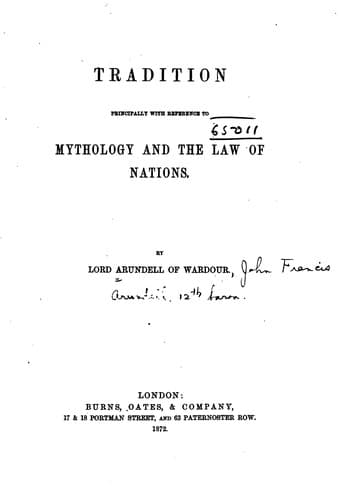
Tradition, Principally with Reference to Mythology and the Law of NationsArundell of Wardour, John Francis Arundell, Baron
Philosophy
Tradition, Principally with Reference to Mythology and the Law of Nations
Arundell of Wardour, John Francis Arundell, Baron
International law; Macdonell, George, 1780-1870; Mythology; Natural law; Tradition (Theology)
"Hoa occupies in the first triad the position which in the
classical mythology is filled by Poseidon or Neptune, and in some
respects he corresponds to him. He is 'the lord of the earth,' just
as Neptune is [Greek: gaiêochos]; he is the 'king of rivers,' and
he comes from the sea to teach the Babylonians, but he is never
called the 'lord of the sea.' That title belongs to Nin or Ninip.
Hoa is the lord of the abyss or of 'the great deep,' which does
not seem to be the sea, but something distinct from it. His most
important titles are those which invest him with the character so
prominently brought out in Oë and Oannes, of the god of science and
knowledge. He is 'the intelligent guide,' or, according to another
interpretation, 'the intelligent fish,' 'the teacher of mankind,'
'the lord of understanding.' One of his emblems is the 'wedge' or
'arrow-head,' the essential element of cuneiform writing, which
seems to be assigned to him as the inventor, or at least the
patron, of the Chaldæan alphabet. Another is the serpent, which
occupies so conspicuous a place among the symbols of the gods
on the black stones recording benefactions, and which sometimes
appears upon the cylinders. This symbol here, as elsewhere, is
emblematic of superhuman knowledge--a record of the primeval
belief that 'the serpent was more subtle than any beast of the
field.' The stellar name of Hoa was Kimmut.... The monuments do
not contain much evidence of the early worship of Hoa. His name
appears on a very ancient stone tablet brought from Mugheir (Ur),
but otherwise his claim to be accounted one of the primeval gods
must rest on the testimony of Berosus and Helladius, who represent
him as known to the first settlers.... As Kimmut, Hoa was also the
father of Nebo, whose functions bear a general resemblance to his
own."--_Rawlinson's Ancient Monarchies_, i. 152.[154]
[154] _Vide_ his other epithets, _infra_, p. 239; also Rawlinson
(Herod. i. p. 600), says that "upon one of the tablets in
the British Museum there is a list of thirty-six synonyms
indicating this god (Hoa). The greater part of them relate
either to "the abyss" or to "knowledge."
Compare this with the following verses from the "Oracula
Sybillina," i. ver. 145--
"Collige, Noë, tuas vires ...
... Si scieris me
Divinæ te nulla rei secreta latebunt."
Now, without entering into the question of the authenticity of
the Sybilline verses, I may at least quote them in evidence of
the current tradition concerning Noah in the second century of
the Christian era, supposing them to have been forged at that
period.
Public-domain text, read in full here on John Shaqi.
Reviews
Reviews
No reviews yet
Be the first to share your thoughts on this work.
Elsewhere in the archive
Join the Discussion
Join the discussion
Sign in to leave a comment or review.
Sign InorCreate an account