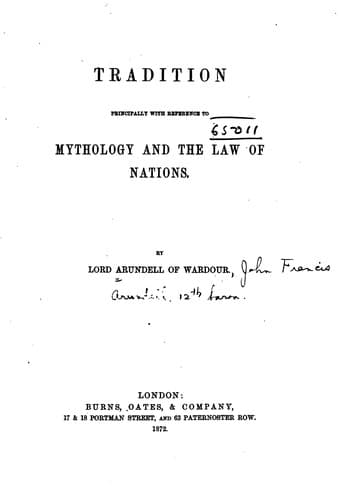
Tradition, Principally with Reference to Mythology and the Law of NationsArundell of Wardour, John Francis Arundell, Baron
Philosophy
Tradition, Principally with Reference to Mythology and the Law of Nations
Arundell of Wardour, John Francis Arundell, Baron
International law; Macdonell, George, 1780-1870; Mythology; Natural law; Tradition (Theology)
I have said that I shall not rely too much on the resemblance of name,
Hoa; but I must draw attention to the curious resemblance which lurks
in the name "Aüs" to the words upon which the Vicomte D'Anselme has
founded an argument in the appended note.[155]
[155] "Comment le nom du premier navigateur connu, tel qu'il se
prononça en Hébreu et qu'il nous est transmis par la Génese,
'Noh, Naus, Noach,' serait-il devenu le nom d'une arche
flottante, d'un navire, en Sanscrit et en vingt autres
langues? _Nau_, sanscrit; _Naw_, armenien; _Naus_, grec;
(_Navis_, latin); _Noi_, hibernien; _Neau_, bas breton; _Nef_,
nav. franc; _Noobh_, irlandais; _Naone_, vanikoro; _Nacho_,
allemand vieux; _Naw_, timor; _Nachen_, allemand; _S'nechia_,
islandais; _S'naeca_ ou _Naca_, anglo-sax.; _S'nace_, ancien
anglais; _Sin-nau_, cambodge, &c.
"Enfin nous demandons comment le nom Hébreu de l'arche de Noë.
Tobe, prononcé comme on écrivait généralement en Orient, en
sens inverse, donne le nom d'un vaisseau dans vingt langues
qui sont des dialectes du Sanscrit? L'écriture boustrophedone,
qui fait les lignes alternativement à droite et gauche
sans interruption a pu donner naissance à cette manière de
lire:--_Boat_, anglais; _boite_, français; _bat_, anglo-saxon;
_boot_, hollandais; _bat_, suedois, _baat_, danois; _batr_,
islandais; _bad_, breton; _bote_, espagnol; _boar_, persan;
_batillo_, italien; _pota_, sanscrit." _Vide_ other similar
proofs from Vicomte d'Anselme's "Monde Païen," &c. In Gainet,
i. 223, a curious additional instance of the same word having
connections with "boat" and arc (_tobe_) might be discovered
in Kibotos, the name of a mountain in Phrygia, where the ark
is said to have rested (Gainet, i. 220). Also we have almost
the same words--ark and arc--to express (though according to a
different etymology) these dissimilar objects.
"The words oar and rudder can be traced back to Sanskrit,
and the name of the ship is identically the same in Sanscrit
(naus, nâvas), in Latin (navis), in Greek (naus), and in
Teutonic, Old High Germ. (nachs), Anglo-Saxon (naca)."--Max
Müller, "Comp. Mythol.," p. 49.
I may draw attention, as having reference to other branches
of this inquiry, to a possible affinity with the name of the
patriarch, in the term _Noaaids_, applied by the Laplanders
to their magicians (Pinkerton, i. 459, &c.); and to the term
Koader_nicks_, applied by the Samoids to the same (_id._ 532).
I own there might be danger in pushing the inquiry further,
as I might even bring the patriarch Noah into contact and
connection with Old Nick!
Public-domain text, read in full here on John Shaqi.
Reviews
Reviews
No reviews yet
Be the first to share your thoughts on this work.
Elsewhere in the archive
Join the Discussion
Join the discussion
Sign in to leave a comment or review.
Sign InorCreate an account