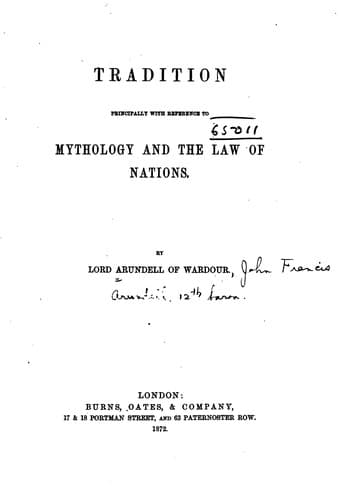
Tradition, Principally with Reference to Mythology and the Law of NationsArundell of Wardour, John Francis Arundell, Baron
Philosophy
Tradition, Principally with Reference to Mythology and the Law of Nations
Arundell of Wardour, John Francis Arundell, Baron
International law; Macdonell, George, 1780-1870; Mythology; Natural law; Tradition (Theology)
I may also refer to the term "Janna" (Janus), as applied to
the officer "who had the office of entertaining ambassadors"
at the court of Kenghis Khan (_id._ v. 7, p. 40; Rubruquis's
Embassy, A.D. 1253, also 56).
In the above extract from Rawlinson, although Hoa is said not to be
"the true fish-god," yet he is called "the intelligent fish," and is
associated with that mystic animal, half man half fish, which came
up from the Persian Gulf to teach astronomy and letters to the first
settlers on Euphrates and Tigris.
Let us compare this information with the following "History of
the Fish," which the Abbé Gainet, i. 199, has translated from the
Mahâbhârata. The same history has been translated from the Bhagavad
Pourana by Sir W. Jones ("Asiatic Researches"). Indeed, as the Abbé
Gainet argues, as this same history is found in all the religious poems
of India, there is a certain security that it would not have been taken
from the Hebrews.
I shall merely attempt to give the drift of the legend from the Abbé
Gainet's original translation of that portion of the Matysia Pourana
which has reference to Noah:--
"The son of Vaivaswata (the sun) was a king, and a great sage,
a prince of men, resembling Pradjapati in _eclat_. In his
strength, splendour, prosperity, and above all, his penitence,
Manou surpassed his father and his grandfather.[156]... One day a
small fish approached him, and begged him to remove him from the
water where he was, 'because the great fish always eat the little
fish--it is our eternal condition.' Manou complies, and the fish
promises eternal gratitude. After several such migrations, through
the intervention of Manou, the fish at each removal increasing in
bulk, he is at length launched in the ocean. The fish then holds
this discourse with Manou:--'Soon, oh blessed Manou, everything
that is by nature fixed and stationary in the terrestrial world,
will undergo a general immersion and a complete dissolution. This
temporary immersion of the world is near at hand, and therefore
it is that I announce to you to-day what you ought to do for your
safety.' He instructs him to build a strong and solid ship, and
to enter it with the _seven_ richis or sages.[157] He instructs
him also to take with him all sorts of seeds, according to
certain Brahminical indications. 'And when you are in the vessel
you will perceive me coming towards you, oh well-beloved of the
saints, I will approach you with a _horn_ on my head, by which
you will recognise me.' Manou did all that was prescribed to him
by the fish, and the earth was submerged accordingly, as he had
predicted. 'Neither the earth, nor the sky, nor the intermediate
space, was visible; all was water.' 'In the middle of the world
thus submerged, O Prince of Bharatidians, were seen the seven
richis or sages, Manou, and the fish. Thus, O King, did this fish
Public-domain text, read in full here on John Shaqi.
Reviews
Reviews
No reviews yet
Be the first to share your thoughts on this work.
Elsewhere in the archive
Join the Discussion
Join the discussion
Sign in to leave a comment or review.
Sign InorCreate an account