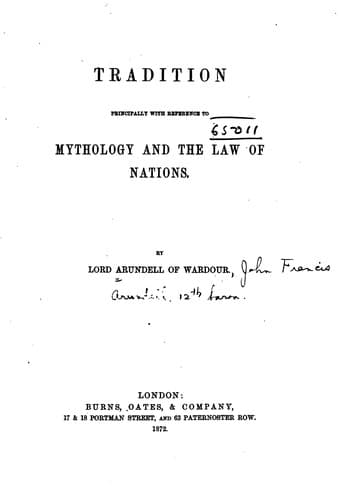
Tradition, Principally with Reference to Mythology and the Law of NationsArundell of Wardour, John Francis Arundell, Baron
Philosophy
Tradition, Principally with Reference to Mythology and the Law of Nations
Arundell of Wardour, John Francis Arundell, Baron
International law; Macdonell, George, 1780-1870; Mythology; Natural law; Tradition (Theology)
cause the vessel to sail' (with a rope tied to its horn), 'for many
years, without wearying, in this immensity of water.' At length
the ship was dragged by the fish on to the highest point of the
Himalaya. 'That is why the highest summit of the Himaran (Himalaya)
was called _Nan_bundhanam, or the place to which the ship was
attached, a name which it bears to this day--_Sache cela, O Prince
des Bharatidians._' Then _le gracieux_, with placid gaze, thus
addressed the richis--'I am Brahma, the ancestor (_l'ancestre_) of
all creatures. No one is greater than I. Under the form of a fish
I came to save you from the terrors of death. From Manou, now,
shall all creatures, with the gods, the demons (_au souras_), and
mankind, be born.... This is the ancient and celebrated history
which bears the name of the 'History of the _Fish_.'"[158]
[156] Comp. "Traditions of the New Zealanders."
[157] Do not the seven richis or sages correspond to the seven (or
eight) (Phoenician) Kabiri. (There were seven or eight
persons in the ark, accordingly as we take separate account
or not of Noah.) As regards the Kabiri, their number (seven
or eight, accordingly as we include "Æsculapius") must be
the clue to the solution of "the most obscure and mysterious
question in mythology." Bunsen ("Egypt," iv. 229) says of an
astral explanation:--"It does not enable us to explain the
details of those representations which do not contain the
number seven (or eight), and, in fact, seven brothers." It
will suffice, from our point of view, if there are numerically
seven persons. Bunsen (iv. p. 291) says--"It is quite clear
that the fundamental number of the gods in the oldest
mythologies of Phoenicia, and all Asia, as well as Egypt,
was seven. There were seven Kabiri, with the seven Titans.
There are also seven Titans mentioned in other genealogies
of the race of Kronos. Of the latter, one dies a virgin and
disappears." But as with the Kabiri we have seen the number
seven, or eight, accordingly as Æsculapius is included or
not, so (vide p. 314) we see the primitive gods of Egypt
either seven or eight, accordingly as Thoth, "the eighth,"
or Horus, figure as the "last divine king" (p. 319). When
Horus so figures, "_he_ is frequently represented as _the
eighth, conducting the bark of the gods_, with _the seven
great gods_," &c. Moreover, it is elsewhere (p. 347) said
that "the Phoenicians, in their sacred books, stated that
the Kabiri _embarked in ships_, and landed near Mount Kaison.
This legend was corroborated by the existence of a shrine
on that coast in historic times." [_Query_, The tradition
of the Deluge localised, and the shrine commemorative of
that catastrophe (_vide_ Boulanger, &c., _infra_, p. 244);
Public-domain text, read in full here on John Shaqi.
Reviews
Reviews
No reviews yet
Be the first to share your thoughts on this work.
Elsewhere in the archive
Join the Discussion
Join the discussion
Sign in to leave a comment or review.
Sign InorCreate an account