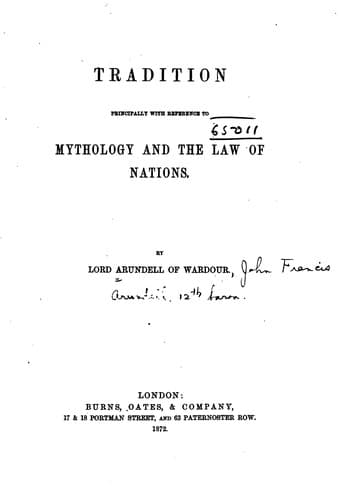
Tradition, Principally with Reference to Mythology and the Law of NationsArundell of Wardour, John Francis Arundell, Baron
Philosophy
Tradition, Principally with Reference to Mythology and the Law of Nations
Arundell of Wardour, John Francis Arundell, Baron
International law; Macdonell, George, 1780-1870; Mythology; Natural law; Tradition (Theology)
and supposing that the tradition of the number saved in the
Flood had been preserved down to a certain date, we should
then expect that the number would become rigid and fixed.
But that if the tradition of the actual survivors had become
indistinct, what more natural than that the eight principal
characters of ante-diluvian, or even post-diluvian, history
should be substituted for them, and that the same confusion
and agglomeration of legend should take place as we shall see
occurring in the tradition of Noah?]
In the Persian or Iranian legend of Shâh-nâmeh, "the three
sons of Ferêdûn--Ireg, Tur, and Selm--are mentioned as
their patriarchs, and among them the _whole earth was
divided_." But in the more ancient Gâthâs there is mention
of "the _seven_-surfaced or _seven_-portioned earth."
[_Query_--apportioned by _the eighth_?] _Vide_ Bunsen's
"Egypt," iii. 478.
For the Indian tradition compare the following from Hunter's
"Bengal" (i. p. 151)--"Another coincidence--I do not
venture to call it an analogy--is to be found in the number
of children born to the first pair. As the Santal legend
immediately divides the human species into _seven_ families,
so the Sanscrit tradition assigns the propagation of _our
race after the flood_ to _seven rishis_." I also find in
F. Schlegel's "Philosophy of History" (p. 150, Robertson's
trans.)--"The Indian traditions acknowledge and revere the
succession of the first ancestors of mankind, or the holy
patriarchs of the primitive world, under the name of the
_seven great rishis_, or sages of hoary antiquity, though they
invest their history with a cloud of fictions."
[158] Syncellus, quoting Berosus (_vide_ Abbé de Tressan,
"Mythology," p. 10), says that _Oannes_ (the mysterious fish,
_vide ante_) left some _writings_ upon the origin of the
world. These, no doubt, correspond to the "Liber Noachi." I do
not disguise that this statement is probably derived from what
is called the false Berosus. The reference, however, which
I have made to these writings at p. 139 may raise doubt
whether they did not embody true traditions.
Here we seem to see what looks like the commencement of the legendary
origin of the fish symbol; and here also we see it unmistakeably in
connection with Noah. We have, moreover, seen the connection of Hoa
with the fish.[159]
Public-domain text, read in full here on John Shaqi.
Reviews
Reviews
No reviews yet
Be the first to share your thoughts on this work.
Elsewhere in the archive
Join the Discussion
Join the discussion
Sign in to leave a comment or review.
Sign InorCreate an account