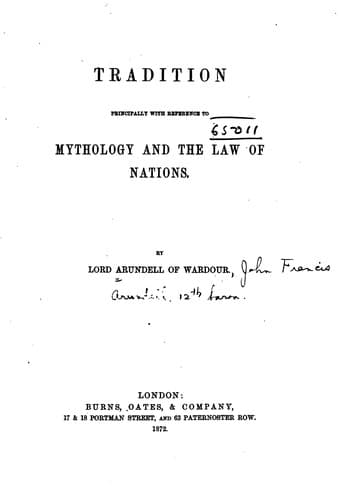
Tradition, Principally with Reference to Mythology and the Law of NationsArundell of Wardour, John Francis Arundell, Baron
Philosophy
Tradition, Principally with Reference to Mythology and the Law of Nations
Arundell of Wardour, John Francis Arundell, Baron
International law; Macdonell, George, 1780-1870; Mythology; Natural law; Tradition (Theology)
[159] I fancy it might be traced also in the Phoenician fish-god,
Dagon. The _Saturday Review_ (June 4, 1870) in its review of
Cox's "Mythology," says--"Dagon cannot be divided Dag-on,
the fish 'On,' for a Semitic syllable cannot begin with a
vowel; and if the necessary breathing 'aleph' were inserted
(which it is very unsafe to do), it would then mean 'the fish
of On,' which is not the signification required." But it is
the signification which would fit in here; moreover, might
not the terminal "aon," or "_haon_," suggested, have been
originally, _i.e._ before displacement by "boustrophedon"--Noa
or Noa_h_? I give this suggestion with all proper diffidence,
and with some genuine misgiving as to the "breathing aleph."
I find that Bryant ("Mythology," iii. p. 116) makes a similar
suggestion.
Bunsen ("Egypt," iv. 243) says--"Dagon is Dagan, _i.e._
corn. This is also implied by the Greek form of it--Sitôn,
wheat-field (comp. p. 219). We have in the Bible, Dagon, a
god of the Philistines, a name usually supposed to be derived
from 'dag,' fish; the god has a human form ending in a fish,
like the fish-shaped goddess, Derketo-Atergatis. It is clear,
from Philo's own account, that the Phoenician Poseidon was
a god of this kind, and it is difficult to find any other
name for him. Yet we cannot say that Dagon is very clearly
explained. Here is a god of agriculture, well authenticated,
both linguistically and documentally, Dagan, _i.e._ wheat,
and he is the _Zeus of agriculture_." _Vide_ p. 219. P. 261
says Dagon must not be confounded with "Dagan," but without
reconciling it with the above at p. 243, on the contrary,
we find "Dagon, Dagan = corn (the fish-man)." At p. 241,
quoting from the _text_ of Philo, it is said still more
pointedly--"Dagon, after he _had discovered corn and the
plough_, was called Zeus Arotnios." Comp. p. 204.
Believing (_vide_ ch. xii.) in the tradition of mythology,
even among savages, I could not but be much struck on coming
upon the following passage in Roggeveen's voyage, to find--in
his account of the Eastern Islanders--the same conjunction of
the bull and fish implied in the traditional names of their
idols:--"The name of the largest idol was called _Taurico_,
and the other _Dago_; at least, these were the words they
called to them by, and wherewith they worshipped them. These
savages had great respect for the two idols, _Taurico_ and
_Dago_, and approached them with great reverence ... and
to supplicate for help against us, and to call upon with a
frightful shout and howling of _Dago! Dago!_" ("Historical
Account of Voyages Round the World," 1774, i. 469, 470.)
Public-domain text, read in full here on John Shaqi.
Reviews
Reviews
No reviews yet
Be the first to share your thoughts on this work.
Elsewhere in the archive
Join the Discussion
Join the discussion
Sign in to leave a comment or review.
Sign InorCreate an account