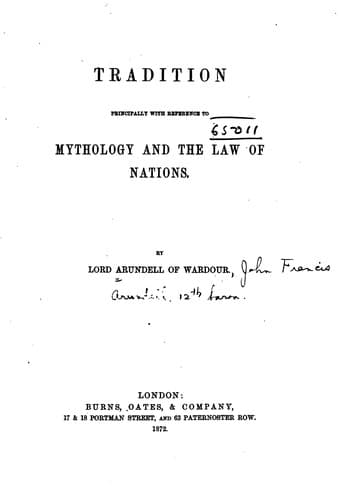
Tradition, Principally with Reference to Mythology and the Law of NationsArundell of Wardour, John Francis Arundell, Baron
Philosophy
Tradition, Principally with Reference to Mythology and the Law of Nations
Arundell of Wardour, John Francis Arundell, Baron
International law; Macdonell, George, 1780-1870; Mythology; Natural law; Tradition (Theology)
After showing the resemblance of a feast at Argos to other
commemorative feasts of the Deluge, Boulanger (_vide infra_,
i. 83) says--"Les Argiens avoient encore une autre fête
pendant laquelle ils précipitoent dans un abîme un agneau....
ils étoient armés de javelines, ils appelloient _Bacchus_
au son des trompettes et l'invitoient _à semontrer hors de
l'eau_; cette apparition n'arrivoit pas fréquemment sans
doute" (comp. _supra_, 197, and 237). "Plutarque remarque
que lors qu'ils précipitoient l'agneau, ils avoient soin de
cacher leurs trompettes et leurs javelines. Nous ne prétendons
point expliquer tous ces mystères." Is it that they feared,
with armed weapons in their hands, to evoke the apparition of
the old man "whose conquests were all peaceful" (p. 216), and
who, as Manco Capac (p. 326), "shut his ears when they spoke
to him of war."
Let us now turn to his reduplication, as I conceive, in Nin, or Ninip,
who is said to be "the true fish god."
"His names, Bar and Nin, are respectively a Semitic and a Hamitic
term, signifying 'Lord,' or 'Master,'" (p. 166). Astronomically Nin
"should be Saturn." However, a set of epithets which _seem to point_ to
his stellar character are very difficult to reconcile with the notion
that, as a celestial luminary, he was (the dark and distant) Saturn.
We find him called, "the light of heaven and earth," "he who, _like_
the sun, the _light_ of the _gods_, irradiates the _nations_." All this
is very difficult to reconcile with legends arising out of the simple
worship of a celestial luminary, but perfectly consistent with the
supposition of the patriarch Noah, after deification, being located
in the planetary system. The phrase, "he who, like the sun, the light
of the gods, irradiates the nations," is perfectly applicable to him
who, as Oannes, we have ever regarded as "the god of science and of
knowledge;" and who "taught astronomy and letters to the first settlers
on the Euphrates and Tigris." Let us glance at the other epithets
applied to Nin in the inscriptions. He is the "lord of the brave,"
"the champion," "the warrior who subdues foes," "_he who strengthens
the hearts of his followers_." [The Scripture mentions the repeated
assurances of the Almighty to Noah, that there should not be another
Deluge; and the above is in keeping with the tradition that the early
inhabitants long hesitated to quit the mountains for the plains, and
only did so incited by the example of the patriarch.] "The destroyer
of enemies," "_the reducer of the disobedient_," "the exterminator
of rebels," "he whose sword is good." Like Nergal, or Mars, he is a
god of battle and the chase. (I shall refer later on to these warlike
epithets as applied to Noah.) At the same time he has qualities which
seem wholly unconnected with any that have been hitherto mentioned.
Public-domain text, read in full here on John Shaqi.
Reviews
Reviews
No reviews yet
Be the first to share your thoughts on this work.
Elsewhere in the archive
Join the Discussion
Join the discussion
Sign in to leave a comment or review.
Sign InorCreate an account