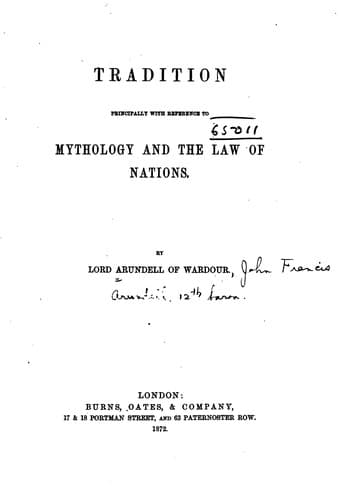
Tradition, Principally with Reference to Mythology and the Law of NationsArundell of Wardour, John Francis Arundell, Baron
Philosophy
Tradition, Principally with Reference to Mythology and the Law of Nations
Arundell of Wardour, John Francis Arundell, Baron
International law; Macdonell, George, 1780-1870; Mythology; Natural law; Tradition (Theology)
He is the true "fish-god" of Berosus, and is figured as such in the
Scriptures. (I hope I may persuade some reader, who may be interested
in this inquiry, to compare the figure of Nin, in Rawlinson, i.
167, with figure 23, Dupaix's "New Spain" in Lord Kingsborough's
"Mexico," representing an emblematic figure with fish[160] (as in the
representation of Nin) over a human head, which also has inverted
tusks. Compare also with representations of Neph, associated with
snake and ram's head, and also with "History of the Fish," _supra_,
p. 197.) To continue--in this point of view he (Nin) is called the
"god of the sea," "he who dwells in the deep;" and again, somewhat
curiously, "the opener of the aqueducts." Now, as applied to Noah,
this is not at all strange, and corresponds to the Scriptural phrase,
"He opened the fountains of the deeps." Subsequently to deification
we cannot be surprised to find all that was done by the Almighty
attributed to the individual to whom it was done; as in Prometheus we
have a double legend of the Creator, who created man with the vital
spark, and of Prometheus, the man who was so created. "Besides these
epithets he has many of a more general character, as 'the _powerful
chief_,' 'the supreme,' 'the _favourite_ of the _gods_,' 'the chief of
the spirits,' and the like."
[160] This closely corresponds to the description of Oannes given by
Sanchoniathon, "Ap. Euseb." (Bryant, ii. 301), _i.e._ with two
heads (comp. _infra_, p. 220), the human head being placed
below the head of a fish:--"[Greek: allên kephalên hypokatô
tês tou ichthyos kephalês]."
I must, moreover, request attention to the following from Rawlinson, i.
168,--"Nin's _emblem_ in _Assyria_ is the _man-bull_, the impersonation
of strength and power. He guards the palaces of the Assyrian kings,
who reckon him their tutelary god, and gives his name to their
capital city. We may conjecture that _in Babylonia_ his _emblem_ was
the _sacred fish_, which is often seen in different forms upon the
cylinders."[161]
[161] _Vide_ similar traditions of the man-bull in India and Japan.
Bryant, iii. 589, who adds, "We shall find hereafter that in
this (Parsee) mythology there were two ancient personages
represented under the same character, and named L'Homme
Taureau; _each_ of whom was looked upon as the _father_ of
mankind." Compare pp. 158, 189, the two Menus and the two
Osiris.
I turn to Gainet, i. 198, and I find this legend concerning the
man-bull from Bertrand's "Dict. des Religions," 38, i. ii.[162]
Public-domain text, read in full here on John Shaqi.
Reviews
Reviews
No reviews yet
Be the first to share your thoughts on this work.
Elsewhere in the archive
Join the Discussion
Join the discussion
Sign in to leave a comment or review.
Sign InorCreate an account