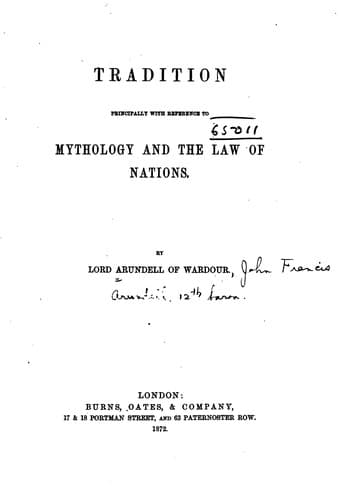
Tradition, Principally with Reference to Mythology and the Law of NationsArundell of Wardour, John Francis Arundell, Baron
Philosophy
Tradition, Principally with Reference to Mythology and the Law of Nations
Arundell of Wardour, John Francis Arundell, Baron
International law; Macdonell, George, 1780-1870; Mythology; Natural law; Tradition (Theology)
[162] The prayer used in the worship of Dionysos at Elis, preserved
by Plutarch, ended with "[Greek: Axie Taure--Axie Taure],"
worthy bull! (_vide_ Bunsen's "Egypt," iv. 446.) Compare p.
215 with Dionysius = Bacchus = Noah; also of the three
Samothracian names of the Kabiri--viz., Axieros, Axiokerse,
Axiokersos. Bunsen says, "the syllable Axi or Axie which is
found in all three, cannot be anything but the Greek word
'Axios,' which was used in the worship of Dionysos at Elis"
(_id., vide infra_).
On this symbol of the bull in connection with Noah and the
Ark _vide_ Bryant (ii. 416, _et seq._ 439). He says, "Every
personage that had any connection with the history of the Ark
was described with some reference to this hieroglyphic ...
that the Apis and Mnenis (Menes) were both representations
of an _ancient personage_ is certain; and who that personage
was may be known from the account given of him by Diodorus.
He speaks of him by the name of Mnenes, but confines his
history to Egypt, as the history of Saturn was limited to
Italy; Inachus and Phoroneus to Argos; Deucalion to Thessaly
... the same person who in Crete was styled Minos, Min-nous,
and whose city was Min-Noa; the same who was represented under
the emblem of Men-taur, or Mino-taurus (_Minotaur_). Diodorus
speaks of Mnenes as the _first lawgiver_," &c., &c....
[Mnenes or Menes may embody traditions of Noah and Misraim,
as Osiris does of Adam and Noah.] At p. 422-435 [plate], we
find Menes represented as a bull _with the sacred dove_....
Plutarch (Isis and Osiris) says the bulls, Apis and Mnenes,
were sacred to Osiris ... and Eustath. (in Dion. v. 308) says
of the Tauric Chersonese, "that the _Tauric_ nation was so
named from the animal Taurus or bull, which was looked upon
as a memorial of _the great husbandman_ Osiris, who first
_taught agriculture_, and to whom was ascribed _the invention_
of the _plough_." ... Lycophron (v. 209 and scholia) says,
[Greek: Tauros], [Greek: Dionysos]. Plutarch says Dionusus
(_vide supra_, p. 203) was styled [Greek: Bougenês], or
the offspring of a bull, by the people of Argos, who used to
invoke him as a _resident of the sea_, and entreat him _to
come out of the waters_. The author of the Orphic hymns calls
him "Taurogenes." [Greek: Taurogenês Dionysos euphrosunên
pore Thnêtois]. [Greek: Taurogenês], is precisely of the
same purport as [Greek: Thêbaigenês] [ark-born], and the
words of this passage certainly mean "that the ark-born deity
Dionusus restored peace and happiness to mortals." [Noah's
name in Scripture signifies "peace and consolation"--[Greek:
Nôe hebraïsianapaysis] (rest), Hesychius.]... The title given
to Diana--viz.
Public-domain text, read in full here on John Shaqi.
Reviews
Reviews
No reviews yet
Be the first to share your thoughts on this work.
Elsewhere in the archive
Join the Discussion
Join the discussion
Sign in to leave a comment or review.
Sign InorCreate an account