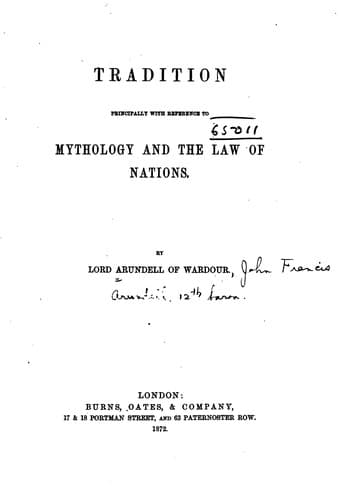
Tradition, Principally with Reference to Mythology and the Law of NationsArundell of Wardour, John Francis Arundell, Baron
Philosophy
Tradition, Principally with Reference to Mythology and the Law of Nations
Arundell of Wardour, John Francis Arundell, Baron
International law; Macdonell, George, 1780-1870; Mythology; Natural law; Tradition (Theology)
[163] Since writing the above I have found the following note
in Rawlinson's "Herodotus," i. 623, on Ninip:--"There is,
however, another explanation of the name Bar-sam or Bur-shem,
of which some notice must be taken. It has been already stated
that if the _Noachid_ triad be compared with the Assyrian, Ana
will correspond with Ham, Bel-Nimrod with Shem, and Hoa with
Japhet."
The following passage, also from Rawlinson's "Herodotus,"
i. 609, appears to me valuable in proof of the transition
from ancestral to solar worship, or at least of their
interfusion:--"The sun was probably named in Babylonia both
San and Sanei, before his title took the definite _Semitic_
form of _Shamas_, by which he is known in Assyrian and _in
all_ the languages of _that family_." Now, standing by itself,
this might not appear very significant; but compare it with
the following passages connecting _Ham_ with the sun:--"By
the Syrians the sun and heat were called ... Chamba; by the
Persians, Hama; and the temple of the sun, the temple of
_Am_mon or _Ham_mon." Mr Bryant shows that Ham was esteemed
the Zeus of Greece and the Jupiter of Latium. Mr G. Higgins'
"Anacalypsis," p. 45. Bryant says, "the worship of Ham, _or
the sun_, as it was the most ancient, so it was the most
universal of any in the world." These passages may possibly be
so interpreted as to support a solar theory, but is it not at
least suspicious to see the name of the central luminary so
apparently identified with historical characters whose memory
is distinctly preserved _aliunde_ in the traditions of their
descendants? Compare Nimrod, ch. viii. 164, _et seq._
It is true that the majority of the inscriptions, p. 169, assert that
Nin was the son of Bel-Nimrod. This may be referred to that tendency,
previously noted in ancient nations, to place the ancestor with whom
they were themselves identified at the head of every genealogy. One
inscription, however, "makes Bel-Nimrod the son of Nin instead of
his father." Nin, in any case, is unquestionably brought into close
historical relationship with Bel-Nimrod, an historical character, and
we must, in fine, choose whether we shall admit him to be Noah--to
whom all the epithets would apply--or whether, upon the more literal
construction of the inscriptions, we shall believe him to be some
nameless son or successor of Nimrod.
There is one god more in whom I fancy I see a counterpart of Noah, or
at least a counterpart of Hoa and Nin--viz.
NEBO.
Public-domain text, read in full here on John Shaqi.
Reviews
Reviews
No reviews yet
Be the first to share your thoughts on this work.
Elsewhere in the archive
Join the Discussion
Join the discussion
Sign in to leave a comment or review.
Sign InorCreate an account