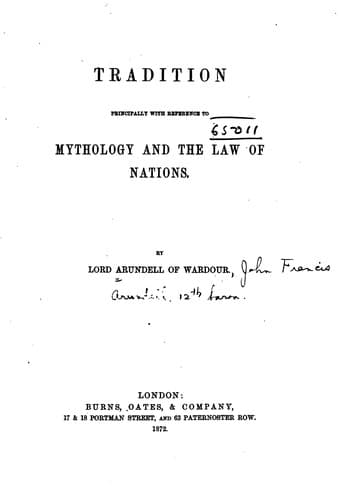
Tradition, Principally with Reference to Mythology and the Law of NationsArundell of Wardour, John Francis Arundell, Baron
Philosophy
Tradition, Principally with Reference to Mythology and the Law of Nations
Arundell of Wardour, John Francis Arundell, Baron
International law; Macdonell, George, 1780-1870; Mythology; Natural law; Tradition (Theology)
[178] Dionusus like Bacchus came to India from _the
west_.--_Philostratus_, lib. ii. 64; _Byrant_, ii. 78. The
Indian Bacchus "appears in the character of a wise and
distinguished oriental monarch; his features an expression of
sublime tranquillity and mildness."--_Smith, Myth. Dic._
[179] This appears to me still more apparent in the 26th Idyll of
Theocritus, where, when the Bacchanals were at their revels,
"Perched on the sheer cliff Pentheus would espy
All....
(For profaning thus "these mysteries weird that must not be
profaned by vulgar eyes," Pentheus is torn to pieces by the
Bacchanals)....
"Warned by this tale, let no man dare defy
Great Bacchus; lest a death more awful should he die.
And when he counts _nine_ years or scarcely _ten_
Rush to his ruin. May I pass my days
_Uprightly_, and be loved by _upright_ men.
And take this motto, all who covet praise
('Twas ægis-bearing Jove that spoke it first),
The godly seed fares well, _the wicked is accurst_."
--_Caverley's Theocritus_, xxvi.
This seems to bear out what is perhaps only vaguely implied in
the sacred text that the curse was on Chanaan--the boy and his
posterity--and not on the whole race of Cham.--_Vide ante_:
also compare the "Bacchæ" of Euripides, in the following
passage from Grote's "Plato" (iii. 333):--"So in the 'Bacchæ'
of Euripides, the two old men, Kadmus and Teiresias, after
vainly attempting to inculcate upon Pentheus the belief in
and the worship of Dionysus, at last appeal to his prudence
and admonish him of the danger of unbelief;" which, if it be
tradition, would look as if Chanaan's offence was only the
final and overt expression of previous unbelief.
III. _Janus._--Janus represented the most ancient tradition of Noah in
Italy; subsequent migrations brought in the legend of Saturn, and thus
we find them variously confounded--Saturn sometimes figuring as his
guest, sometimes as his son, sometimes as his colleague on the throne.
Like Saturn he appears as double-headed or bifrons, he is said to have
introduced civilisation among the wild tribes of Italy, and under him,
as under Saturn, there appears to have been a golden age.
I have made reference to _Saturn_ as Oceanus (_vide Montfauçon_, i.
5), and as Oceanus his representations are very remarkable. In one
he appears as an old man sitting on the waves of the sea, with a _sea
monster_ on one side of him, and his spear or rod in his hand. In
another as sitting on the waves of the sea with ships about him; he is
"holding an urn and pours out water, the symbol of _the sea, and also
of rivers and fountains_."
Public-domain text, read in full here on John Shaqi.
Reviews
Reviews
No reviews yet
Be the first to share your thoughts on this work.
Elsewhere in the archive
Join the Discussion
Join the discussion
Sign in to leave a comment or review.
Sign InorCreate an account