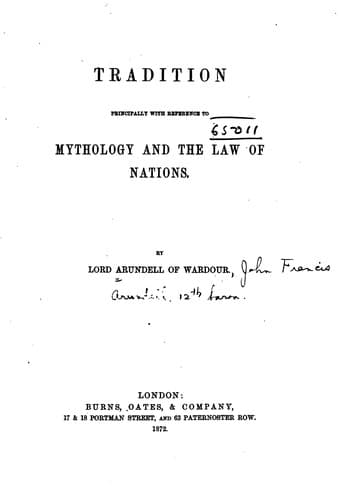
Tradition, Principally with Reference to Mythology and the Law of NationsArundell of Wardour, John Francis Arundell, Baron
Philosophy
Tradition, Principally with Reference to Mythology and the Law of Nations
Arundell of Wardour, John Francis Arundell, Baron
International law; Macdonell, George, 1780-1870; Mythology; Natural law; Tradition (Theology)
_But Janus is also_ represented in his medals "with a prow of a ship on
the reverse," and he is said to have first invented crowns, _ships_,
and _boats_, and to have coined the first money.
"According to the accounts of mythologists," says Macrobius, "_all
families in the time of Janus_ were full of religion and _holiness_."
"Xenon says he was the first that built temples and instituted sacred
rites," and was therefore always mentioned at the beginning of
sacrifices.
With reference to his description as "bifrons," Macrobius says (some
say) he was so called "because he knew the past and future things....
Some pretend to prove that Janus is the Sun, and that he is represented
with two faces, because he is master of the two _doors_[180] of heaven,
and opens the day at his rising and shuts it at his setting."
[180] _Vide_ Dr Smith's "Myth. Dict." art. Janus:--"Whereas the
worship of _Janus_ was introduced at Rome by Romulus, that of
_Sol_ was instituted by _Titus Tatius_."
A good secondary explanation is,[181] that "as Janus always began the
year" (whence January) "the two heads do look on and import the old
and new year;" but then occurs the question--and this is why I submit
that it is only a secondary explanation--how came Janus to commence the
year?
[181] If Janus is allowed to have been identified with Saturn
(_supra_) we may see through the analogy of Saturn how these
secondary functions came to be attributed to him--Saturn was
also Chronos [that Chronos = Noah, _vide_ _Palmer's Egypt.
Chron._, i. p. 60]; "but," as Dr Smith says, "there is no
resemblance between the deities, except that both were
regarded as the most ancient deities in their respective
countries." As Chronos simply personifies antiquity itself,
this only means that Saturn was the most ancient deity. When
subsequently he became merged in "Chronos," his ancient sickle
became converted into a scythe. Dr Smith ("Dict. Myth.")
says, "He held in his hand a crooked pruning knife, and his
feet were surrounded with a _woollen_ riband;" and Goguet
("Origin of Laws," i. 94) says, "All old traditions speak of
the _sickle_ of Saturn, who is said to have taught the people
of his time to cultivate the earth."--_Plut._ i. p. 2, 275;
_Macrob. Sat._, lib. i. 217.
Goguet ("Origin of Laws," i. 283) says, "Several critics are
of opinion that the Janus of the ancients is the same with
Javan the son of Japhet, Gen. x. 3."
Public-domain text, read in full here on John Shaqi.
Reviews
Reviews
No reviews yet
Be the first to share your thoughts on this work.
Elsewhere in the archive
Join the Discussion
Join the discussion
Sign in to leave a comment or review.
Sign InorCreate an account