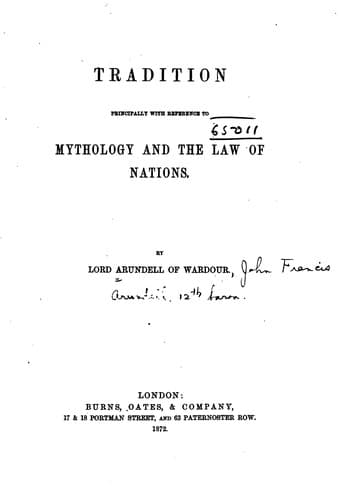
Tradition, Principally with Reference to Mythology and the Law of NationsArundell of Wardour, John Francis Arundell, Baron
Philosophy
Tradition, Principally with Reference to Mythology and the Law of Nations
Arundell of Wardour, John Francis Arundell, Baron
International law; Macdonell, George, 1780-1870; Mythology; Natural law; Tradition (Theology)
It may afford a clue if I advert to the circumstance that
whilst in the Phoenician alphabet (_vide Bunsen's Egypt_.
iv. 290, 293, 297), Dagon, Dagan = Corn (the Fish-man,
_vide supra_, p. 200), stands for the letter D. "The
door" is its hieroglyphic equivalent. Thus we get in strange
juxtaposition what we may call symbols, connecting Janus with
the Fish-god and with the god of agriculture.--_Vide supra_,
p. 200, and _infra_.
In the nomenclature of the calendar connected with any system of hero
worship, worship of ancestors, or even spirit worship, who more fitly
chosen to commence the year than Janus, supposing him to be Noah?
There are, however, two what we may call primary explanations, and
we must take our choice. The epithet is either applied to him, as
exactly according with the reminiscence of Noah, who was pre-eminently
acquainted with the past and the future; or we can take the astral
explanation that Janus was called Bifrons,[182] because he opened the
sun at his rising and shut it at his setting. As a symbol of Noah
this double head appears to me very simple and natural, Noah forming
the connecting link between the antediluvian and modern worlds; but as
applied to the Sun or to Janus as in relation to the Sun, even allowing
for personification, this twofold head of man strikes me as incongruous
in the extreme. Besides, if it be allowed that it might apply to Saturn
and Janus through the connecting idea of Chronos, how does it apply to
_Bacchus_? Let us press this argument further. Here is a symbol common
to Bacchus, Saturn, and Janus, and combining harmoniously in each
instance with the representation of Noah. Can this symbol, common to
these three, combine even congruously with any solar or astral legend?
I have somewhere seen it noted as suspicious and as tending to confirm
the solar theory that these mythological personages all "journey from
_east_ to west, and meet their fate in the evening." But is this so?
Have we not just seen that Bacchus, according to mythology, travelled
from the _west_ into India?
Public-domain text, read in full here on John Shaqi.
Reviews
Reviews
No reviews yet
Be the first to share your thoughts on this work.
Elsewhere in the archive
Join the Discussion
Join the discussion
Sign in to leave a comment or review.
Sign InorCreate an account