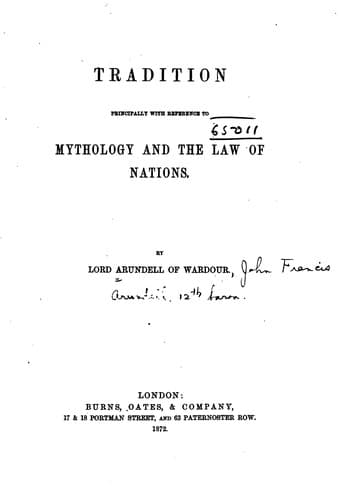
Tradition, Principally with Reference to Mythology and the Law of NationsArundell of Wardour, John Francis Arundell, Baron
Philosophy
Tradition, Principally with Reference to Mythology and the Law of Nations
Arundell of Wardour, John Francis Arundell, Baron
International law; Macdonell, George, 1780-1870; Mythology; Natural law; Tradition (Theology)
This digression on the legend of Deucalion has led me away from what is
properly the subject-matter of this inquiry; and I therefore propose
now to summarise the results of the last two chapters. To pursue the
tradition of Noah in all its ramifications would extend the inquiry
beyond the scope which is necessary for the purposes of my argument.
It will have been seen, I think, that my object has not been merely
antiquarian research. I have sought to bring into prominence the
reminiscences of Noah, which recall him at any rate as the depository
of the traditions, if not the expositor of the science of mankind, as
the channel, if not the fountain-head, of law, which thus became the
law of nations--as the intermediary through whom the communications of
the Most High passed to mankind, and under whose authority mankind held
together during some three hundred years.[197]
[197] Gen. vi. 18; viii. 15; vi. 13; ix. 8; viii. 20; ix. 20; and
Ecclesiasticus xliv. 1, 3, 4, 19, "The covenants of the world
were made with Him."
Let me collect more directly and more fully the epithets in this sense
which are dispersed in the above traditions.
We have seen that Calmet properly identifies Saturn with Noah; that
according to Virgil and Plutarch "under Saturn was the golden age;"
Saturn of whom Hesiod says:--"Him of mazy counsel, Saturn;" that in
the tradition, as we see it in Virgil, he is described as bringing his
scattered people into social life, and the noticeable phrase is used
_legesque dedit_;[198] that in Bacchus, directly connected with Saturn
through the _Saturnalia_, we also see much in his characteristics in
common with Saturn, all which equally identifies him with Noah; and
Bacchus, as we are told by Cicero, was the author of the "laws called
Subazian."[199] In Janus, too, we find great resemblances to Saturn,
and in the very respects which would identify him with Noah. Under
Janus as under Saturn was the golden age, and it is added that in the
time of Janus, "all families were full of religion and holiness," and
although his rule is described as singularly peaceful, he is called
Quirinus and Martialis, as presiding over war. The closing and opening
of his temple, too, had a conspicuous and direct connection with peace
and war.
[198] I feel justified in bringing in attestation also the following
verses of the "Oracula Sybillina," for, as I have already
said, even if they be forgeries of the second century A.D.,
they at any rate represent the tradition at that date (i. v.
270):--
Public-domain text, read in full here on John Shaqi.
Reviews
Reviews
No reviews yet
Be the first to share your thoughts on this work.
Elsewhere in the archive
Join the Discussion
Join the discussion
Sign in to leave a comment or review.
Sign InorCreate an account