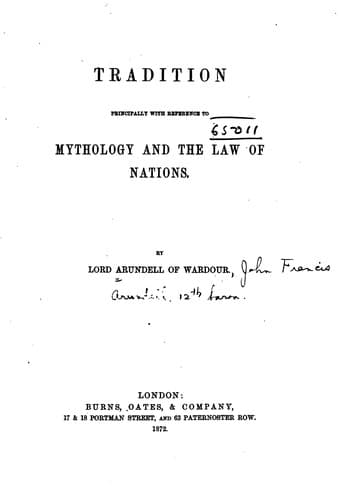
Tradition, Principally with Reference to Mythology and the Law of NationsArundell of Wardour, John Francis Arundell, Baron
Philosophy
Tradition, Principally with Reference to Mythology and the Law of Nations
Arundell of Wardour, John Francis Arundell, Baron
International law; Macdonell, George, 1780-1870; Mythology; Natural law; Tradition (Theology)
"Noë fidelis amans æqui servata periclis
Egredere audenter, simul et cum conjuge nati
Tresque nurus: et vos terræ loca vasta replete,
Crescite multiplice numero, _sacrataque jura
Tradite_ natorum natis....
Hinc nova progenies hinc _ætas aurea_ prima
Exorta est hominum....
... ast illo se tempore regia primum
Imperia ostendent terris quum _foedere facto_
Tres justi reges, divisis partibus æquis,
_Sceptra_ diu populis imponent _sanctaque tradent
Jura_ viris."...
Compare also the following verses (Orac. Sybil, i. 145) with
the Vedic tradition (_infra_, p. 238) of the promise made
to Satiavrata, and the Babylonian tradition respecting Hoa
(_infra_):
"... Collige, Noë, tuas vires ...
... Si scieris me
Divinæ te nulla rei secreta latebunt."
[199] I only instance this as evidence that laws of some sort were
attributed to Bacchus, whom the traditions also speak of as
King of Asia: to judge of these laws by what we know of the
Subazian mysteries, would be as if we were to form our opinion
of the Mandan ceremonies (_vide infra_, ch. xi.) by the last
day's orgies only. In this matter we may say with Cicero, _De
Legibus_, ii. 17--"Omnia tum perditorum civium scelere ...
religionum jura polluta sunt."
If we turn back to the mythological prototypes in Assyria we find him
as Hoa in connection with "the mystic animal, half-man half-fish, which
came up from the Persian Gulf to teach astronomy and letters to the
first settlers on the Euphrates and Tigris," himself "known to the
first settlers;" he is called "the intelligent guide, or, according
to another interpretation, the intelligent fish," "the teacher of
mankind," "the lord of understanding;" "one of his emblems is the
wedge or arrow-head, the essential emblem of cuneiform writing, which
seems to be assigned to him as the inventor, or at least the patron of
the Chaldæan alphabet." In the Vedic tradition as Satiavrata (_vide_
Rawlinson's "Bampton Lect.," lect. ii. 67), having been saved "from
the destroying waves" in "a large vessel" sent from heaven for his
use--which he entered accompanied "by pairs of all brute animals"--he
is thus addressed, "Then shalt thou know my true greatness, rightly
named the Supreme Godhead; by my favour all thy questions _shall be
answered_ and thy mind abundantly instructed;" and it is added that
"after the deluge had abated," Satiavrata was "instructed in all
_human_ and _divine_ knowledge." In fine, if we recognise him as Hoa,
we shall find his benefactions to mankind thus summed up in Berosus.
(_Vide_ the original in Rawlinson's "Ancient Monarchies," i. 154.)[200]
Public-domain text, read in full here on John Shaqi.
Reviews
Reviews
No reviews yet
Be the first to share your thoughts on this work.
Elsewhere in the archive
Join the Discussion
Join the discussion
Sign in to leave a comment or review.
Sign InorCreate an account