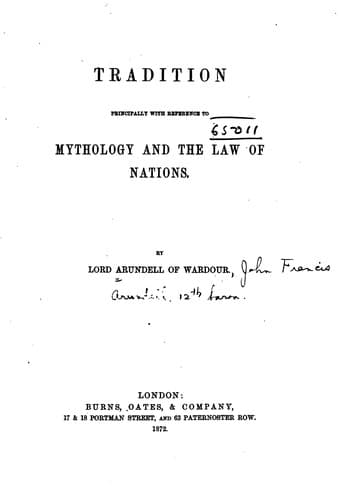
Tradition, Principally with Reference to Mythology and the Law of NationsArundell of Wardour, John Francis Arundell, Baron
Philosophy
Tradition, Principally with Reference to Mythology and the Law of Nations
Arundell of Wardour, John Francis Arundell, Baron
International law; Macdonell, George, 1780-1870; Mythology; Natural law; Tradition (Theology)
[225] As far as I can ascertain, the pheasant is not a native of
America. Yarrell speaks of it as Asiatic, and that it has
been domesticated "in all parts of the _old_ continent."
So also Gould. Of the American writers, _neither_ Wilson,
Audubon, Bonaparte, Nuttall, Richardson, or Jameson include
the pheasant. Mr Catlin, however, says, p. 44: "From the
translation of their name, already mentioned (Nu-mah-ká-kee,
pheasants), an important inference may be drawn in support of
the probability of their having formerly lived much farther
to the south, as that bird does not exist on the prairies of
the Upper Missouri, and is not to be met with short of the
hoary forests of Ohio and Indiana, eighteen hundred miles
south of the last residence of the Mandans. In their familiar
name of Mandan, which is not an Indian word, there are equally
singular and important features. In the first place, that they
knew nothing of the name or how they got it; and next, that
the word Mandan in the Welsh language [Mr C.'s theory is that
they are the survivors of Prince Madoc's expedition from Wales
in the fourteenth century] means red dye, of which further
mention will be made." On the legend of the Welsh expedition,
_vide_ Warburton's "Conquest of Canada," ii., Appendix iv.
[226] "The Indians resemble the people of north-eastern Asia in form
and feature more than any other of the human race; their
population is most dense along the districts nearest to Asia;
and among the Mexicans, whose records of the past deserve
credence, there is a constant tradition that their Aztec
and Toltec chiefs came from the north-west."--Warburton's
"Conquest of Canada," i. 195.
Brace ("Manual of Ethnology," p. 115) says, after noting
that whereas the prominence in the head "is anterior in the
Chinese rather than lateral, as in the American Indians and
the Tangusic tribes," adds, "The peculiar distinguishing
characteristics are the smallness of the eyes and the
obliquity of the eyelids. The nose is usually small and
depressed, though sometimes, in favourable physical
conditions, natives are found with a slightly aquiline nose,
_giving the face a close resemblance to that of the American
Indians or New Zealanders_."
Refer to argument at p. 70, with reference to the Mozca
Indians.
To the peculiarity of name, and resemblance of feature, I shall now
proceed to add the evidence of some traces of their peculiar customs,
or at least of some trace of the tradition out of which they arose.
Public-domain text, read in full here on John Shaqi.
Reviews
Reviews
No reviews yet
Be the first to share your thoughts on this work.
Elsewhere in the archive
Join the Discussion
Join the discussion
Sign in to leave a comment or review.
Sign InorCreate an account