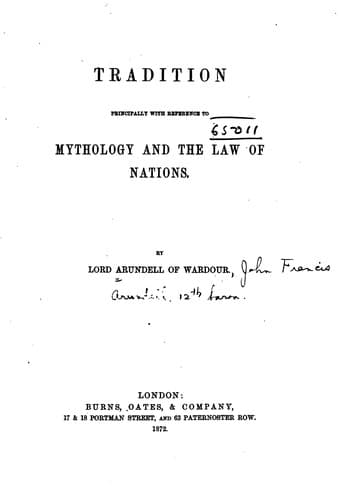
Tradition, Principally with Reference to Mythology and the Law of NationsArundell of Wardour, John Francis Arundell, Baron
Philosophy
Tradition, Principally with Reference to Mythology and the Law of Nations
Arundell of Wardour, John Francis Arundell, Baron
International law; Macdonell, George, 1780-1870; Mythology; Natural law; Tradition (Theology)
I am not at present in possession of evidence to show this in the
Corea itself (almost totally unknown and unexplored), but in the
island of Formosa the same mode of burial is observed, only that
among the Formosans other customs are added, which remind one of the
commemorative customs of the Mandans.
CATLIN, p. 8.
"Their (Mandan) dead, partially embalmed, are
tightly wrapped in buffalo hides softened with
glue and water, and placed on slight scaffolds,
above the reach of animals or human hands, each
body having its separate scaffold."
The Mandan dance was round "_the big canoe_,"
and a part of their ceremony on the roof of
their wigwams.
Among the Opischeschaht _Indians_ (_vide Field_,
Oct. 2, 1869) there was a dance which they
called "the roof dance." "While the dance and
song were going on below, leaped up and down
between the roof-board, pushed aside for that
purpose, making a noise like thunder.... After
the dance was finished an old Seshaaht came
forward, and remarked, that as it was a dance
peculiar to his tribe it could not be omitted,"
though "very injurious to the roof."
OGILBY'S JAPAN, p. 52.
"The manner of disposing of their (Formosans')
dead and funeral obsequies is thus: When any
one dies, the corpse being laid out, after
twenty-four hours they elevate it upon a
convenient scaffold or stage, four feet high,
matted with reeds and rushes, near which they
make a fire, so that the corpse may dry by
degrees.... They drink intoxicating liquors. One
beats on a drum made _like a chest_, but _longer_
and _broader_, and turning _the bottom upwards_;
the women get up, and two by two, back to back,
move their legs and arms in a dancing time and
measure, which pace, or taboring tread, sends
a kind of murmuring or doleful sound from the
_hollow tree_."
_N.B._--Their boats were constructed by hollowing
out a tree (_vide_ Catlin's "Last Rambles," p.
99).[227]
[227] Compare what Ogilby (p. 36) says: "Near Firando (Japan) at an
_inlet of the sea_ stands an idol, _being nothing but a chest
of wood_, about three feet high, _standing like an altar_ [the
big canoe was placed on end among the Mandans], whither women,
when they suppose they have conceived, go in pilgrimage,
offering on their knees rice or other presents." At p. 136, at
Jado, it is said, "somewhat farther stands a temple _dedicated
to all sorts of animals with a very high double roof_."
(Query, Noah's ark?)
Public-domain text, read in full here on John Shaqi.
Reviews
Reviews
No reviews yet
Be the first to share your thoughts on this work.
Elsewhere in the archive
Join the Discussion
Join the discussion
Sign in to leave a comment or review.
Sign InorCreate an account