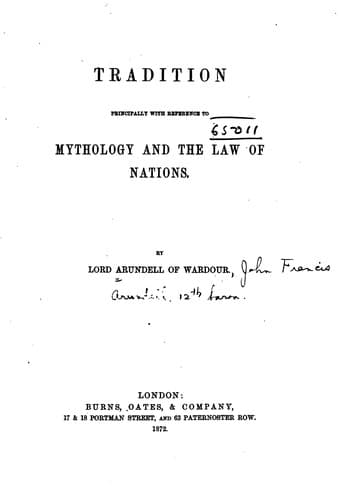
Tradition, Principally with Reference to Mythology and the Law of NationsArundell of Wardour, John Francis Arundell, Baron
Philosophy
Tradition, Principally with Reference to Mythology and the Law of Nations
Arundell of Wardour, John Francis Arundell, Baron
International law; Macdonell, George, 1780-1870; Mythology; Natural law; Tradition (Theology)
In the _Illustrated London News_, January 13, 1872, its
correspondent from Yokohama gives a short account of
the Japanese religious festivals, in which among other
coincidences I note the following: "The most absurd," he says,
"is one in which the foul fiend is simultaneously expelled
from every house by dint of pelting him with boiled peas. The
devil is chased out of the town with a dance of derision, by
young fellows in grotesque costumes, for the public mirth."
Compare with the scene in the Mandan ceremonies, described by
Catlin, _vide supra_, p. 260.
Now, compare with the above, and also with the extracts from Burton and
Catlin, at p. 254, remembering the prominence of the ox or bull (the
ox and bull dance) in the Mandan customs, and the connection of the
bull with Nin or Ninip, p. 200, 203, and other mythological figures
of which I believe Noah to have been the antitype. The following
description of the most curious traditional representation in Japan
(Ogilby, p. 279):--
"Moreover, besides the ox temple in Meaco, there is also to be seen
the stately chapel dedicated to the Creator of all things (the
ox in the above-mentioned temple is represented as breaking the
mundane egg, _vide supra_, p. 257), who is represented in a very
strange manner. In the middle of the temple is a great pot _full
of water_ surrounded with a wall, seven feet high from the ground,
in the middle of which appears an _exceeding great tortoise_,
whose shell, feet, and head stands in the water; out of its back
rises the body of a great tree, on the top of which sits a strange
and horrible figure" ... [then follows a good deal which has its
explanation, but must be curtailed] ... "the image hath four arms"
... in one "the hand grasps a cruse, _from whence water issues
continually_; the other hand _holds a sceptre_.... The tree whereon
he sits is of brass, ... about the middle of this tree an exceeding
great serpent hath wreathed itself _twice_, whose head and body is
on the right side held fast by two horrible shapes, the remaining
part thereof to the tail, two kings and one of Japan sages stretch
forth" [evidently representing the contending influences (as in
Mandan dance), one of the kings having the duplicated Janus head,
_supra_, p. 220.][228]
Public-domain text, read in full here on John Shaqi.
Reviews
Reviews
No reviews yet
Be the first to share your thoughts on this work.
Elsewhere in the archive
Join the Discussion
Join the discussion
Sign in to leave a comment or review.
Sign InorCreate an account