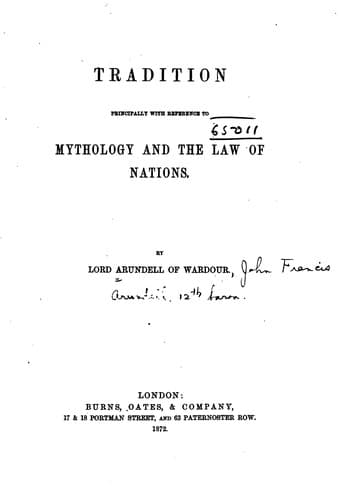
Tradition, Principally with Reference to Mythology and the Law of NationsArundell of Wardour, John Francis Arundell, Baron
Philosophy
Tradition, Principally with Reference to Mythology and the Law of Nations
Arundell of Wardour, John Francis Arundell, Baron
International law; Macdonell, George, 1780-1870; Mythology; Natural law; Tradition (Theology)
As a geologist Sir John Lubbock may be entitled to rely mainly upon the
geological evidence of a palæolithic age;[241] but as an ethnologist
dealing with history and writing on the subject of tradition, his
argument, however incontrovertible he may deem it, sinks to the second
rank; and secondary I shall take the liberty of considering it. On the
same grounds, though I think with more reason, that Sir J. Lubbock
seeks to be relieved from "the embarrassing interference of tradition"
("Pre-historic Times," p. 336), I protest, when tradition is the
subject-matter of the discussion, against a geological argument being
brought to take the ground from under our feet!
[241] It may perhaps be doubtful to what extent Sir J. Lubbock
maintains his theory of a Stone Age; although Sir John
formally excludes China and Japan from the argument, he
nevertheless appears to me to assume the existence of
universal transitional periods through which the human race
necessarily passed. "It would appear that pre-historic
archæology may be divided into four great epochs. Firstly,
that of the Drift: when man shared the possession of Europe
with the mammoth, &c. This we may call the 'palæolithic
period.' Secondly, the later or polished Stone Age; a period,
&c. Thirdly, the Bronze Age, &c. Fourthly, the Iron Age." Sir
John adds, certainly--"In order to prevent misapprehension,
it may be well to state at once, that for the present I only
apply this classification to Europe, though in all probability
it might be extended also to the neighbouring parts of Asia
and Africa. As regards other civilised countries, China
and Japan for instance, we as yet know nothing of their
pre-historic archæology. [I should rather say, as we as
yet have no reason to suppose that they have ever lost the
knowledge of metals.] It is evident also that some nations,
such as the Fuegians, Andamaners, &c., are _even now_ only
in an age of stone. But even in this limited sense, the
above classification has not met with general acceptance;
there _are still some_ archæologists who believe that the
arms and implements--stone, bronze, and iron--were used
contemporaneously."--_Pre-historic Times_, pp. 2, 3. I think
that the concluding sentence makes it quite clear that Sir
John assumes the existence of universal progressive periods
as above. In any case it may be proved in this way. Sir John
argues upon the hypothesis of the unity of the human race; and
I also think that he will not refuse the unbroken testimony
to the fact of the civilisation of Europe from Asia. Either,
then, the _first_ colonisation took place when Asia was in the
state of the "Drift," or in the "later polished Stone Age," or
else the migration left Asia with the knowledge of bronze or
iron.
Public-domain text, read in full here on John Shaqi.
Reviews
Reviews
No reviews yet
Be the first to share your thoughts on this work.
Elsewhere in the archive
Join the Discussion
Join the discussion
Sign in to leave a comment or review.
Sign InorCreate an account