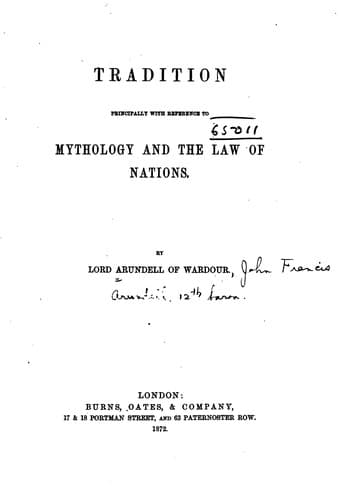
Tradition, Principally with Reference to Mythology and the Law of NationsArundell of Wardour, John Francis Arundell, Baron
Philosophy
Tradition, Principally with Reference to Mythology and the Law of Nations
Arundell of Wardour, John Francis Arundell, Baron
International law; Macdonell, George, 1780-1870; Mythology; Natural law; Tradition (Theology)
On the latter supposition the argument I contend for is
conceded, and original civilisation and subsequent degeneracy
is established. To escape this alternative the universality of
a Stone Age in Asia as well as in Europe, must be proved or
assumed. This assumption I maintain is essential to Sir John's
argument.
In the first place, I beg to urge that if Sir J. Lubbuck's argument be
well founded, Professor Rawlinson's reconstruction of Assyrian history
cannot be true. Now I assume that the one order of facts is as well
established as the other.
If Professor Rawlinson takes back Assyrian history and corroborates
history and tradition by the evidence of recent excavations to
B.C. 2234, identifies the Erech of Scripture with the Huruk
of the cuneiform tablets and the modern Urka; similarly identifies the
other three cities of Nimrod; and, finally, identifies Nimrod himself
as Bil-Nipru; and if, further, bronze implements are found (Rawlinson,
i. 101, 123, 211), along with flint doubtless (but this was common
throughout the bronze age, as Sir John himself admits), at an early
period;--and bronze, though comparatively rare, yet exists among the
very early Assyrian remains--there seems no good reason to suppose that
the knowledge of metals, which we know (Gen. iv. 22) to have existed
before the Deluge, and which the construction of the ark presupposes,
was ever lost.
A stone age, exclusive of metals, common to the whole world and to
all mankind, is therefore an untenable hypothesis according to the
testimony of history. If it existed anywhere it must have been only
partially, locally, and contemporaneously with this traditional
knowledge of metals, which seems to be historically proved.[242] I
may at least be permitted to believe in the accuracy of Professor
Rawlinson's conclusions, and to regard them as the verdict of
history: and if the historical arguments so pronounce, why should the
geological or palæontological argument override it? Is not history
supreme on its own ground--and if Scripture is always found in perfect
consistency with history, is it not as much as in strictness we should
have a right to expect? "Tradidit mundum disputationi eorum" (Eccles.
iii. 11).
Public-domain text, read in full here on John Shaqi.
Reviews
Reviews
No reviews yet
Be the first to share your thoughts on this work.
Elsewhere in the archive
Join the Discussion
Join the discussion
Sign in to leave a comment or review.
Sign InorCreate an account