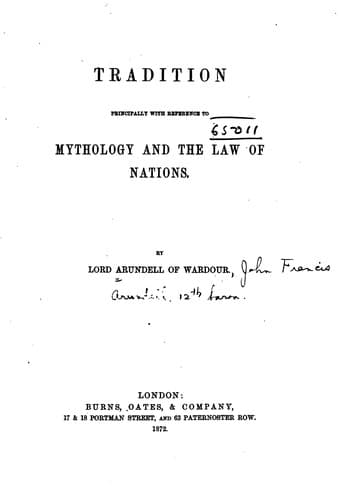
Tradition, Principally with Reference to Mythology and the Law of NationsArundell of Wardour, John Francis Arundell, Baron
Philosophy
Tradition, Principally with Reference to Mythology and the Law of Nations
Arundell of Wardour, John Francis Arundell, Baron
International law; Macdonell, George, 1780-1870; Mythology; Natural law; Tradition (Theology)
[242] Wilson ("Archæologia of Scotland," 360) says, "But after all
it is to Asia we are forced to return for the _true source
of nearly all our primitive arts_, nor will the canons of
archæology be established on a safe foundation till the
antiquities of that older continent have been explored and
classified." Not only bronze but iron has been found in the
East in use at an early period (_vide_ Layard, "Nineveh and
Babylon," 178-9, 194). At Nimroud, Dr Percy (_id._ 670) says
the iron was used to economise the bronze; if so it must have
been cheaper, and therefore probably more abundant; and he
is of opinion that "iron was more extensively used by the
ancients than seems to be generally admitted." Philology seems
also to establish an early common knowledge, and subsequent
tradition of the use of metals. Mr Max Müller (ii. 45) says,
"That the value and usefulness of some of the metals was known
before the separation of the Aryan race can be proved only
by a few words; for the names of most of the metals differ
in different countries. Yet there can be no doubt that iron
was known, and its value appreciated, whether for defence
or attack. Whatever its old Aryan name may have been, it is
clear that Sanscrit 'ayas,' Latin 'ahes,' in 'ahencus' and
even the contracted form 'æs, æris'; the Gothic 'ais,' the
old German 'er,' and the English iron, are names cast in the
same mould, and only slightly corroded even now by the rust of
so many centuries." The Swedish Gothic race had no tradition
but of weapons of iron. (Professor Nillson's "Stone Age," p.
192.) I find in Captain Cook's Voyages that in Otaheite their
word for iron is "eure-eure." Germans (_apud_ Tacitus) called
their iron lances "framea," which has great resemblance to
_ferrum_. (_Vide_ Wilson, 195.) The following passage from
Wilson's "Archæologia" seems to prove this common terminology
still more extensively--"The Saxon 'gold' differs not more
essentially from the Greek '[Greek: chrysos]' than from the
Latin 'aurum'; iron from '[Greek: sideros]' or 'ferrum';
_but_ when we come to examine the Celtic names of the metals
it is otherwise. The Celtic terms are: Gold: Gael, 'or,'
golden, 'orail'; Welsh, 'aur'; Latin, ' aurum.' Silver: Gael,
'airgiod,' made of silver, 'airgiodach'; Welsh, 'ariant';
Latin, 'argentum'--derived in the Celtic from 'arg,' white, or
milk, like the Greek '[Greek: argos],' whence they also formed
their '[Greek: argyros].' Now, is it improbable that the Latin
'ferrum' and the English 'iron' spring indirectly from the
same Celtic root? Gael, '_iarunn_'; Welsh, '_haiarn_'; Saxon,
iron; Danish, 'iern'; Spanish, 'hierro,' which last furnishes
Public-domain text, read in full here on John Shaqi.
Reviews
Reviews
No reviews yet
Be the first to share your thoughts on this work.
Elsewhere in the archive
Join the Discussion
Join the discussion
Sign in to leave a comment or review.
Sign InorCreate an account