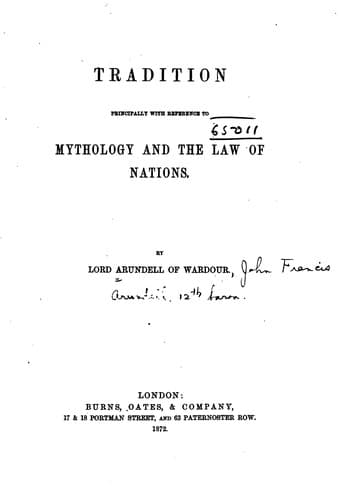
Tradition, Principally with Reference to Mythology and the Law of NationsArundell of Wardour, John Francis Arundell, Baron
Philosophy
Tradition, Principally with Reference to Mythology and the Law of Nations
Arundell of Wardour, John Francis Arundell, Baron
International law; Macdonell, George, 1780-1870; Mythology; Natural law; Tradition (Theology)
no remote approximation to 'ferrum.' Nor with the older metals
is it greatly different, as bronze, Gael, 'umha' or '_prais_';
Welsh, 'pres,' whence our English 'brass,' a name bearing no
very indistinct resemblance to the Roman 'æs.' Lead in like
manner has its peculiar Gaelic name 'luaidha,' like the Saxon
'læd' (lead), while the Welsh 'plwm' closely approximates to
the Latin 'plumbum.' It may undoubtedly be argued that the
Latin is the root instead of the offshoot of these Celtic
names, but the entire archæological proofs are opposed to this
idea," p. 350.
Sir J. Lubbock, "Pre-historic Times" (p. 372) says, "The tools
of the Tahitians when first discovered were made of stone,
bone, shell, or wood. Of metal they had no idea. When they
first obtained nails they mistook them for the young shoots of
some very hard wood, and hoping that life might not be quite
extinct, planted a number of them carefully in their gardens."
Captain Wallis, however, speaking of the islands within the
Polynesian group, remarks "as an extraordinary circumstance
that although no sort of metal was seen on any of the lately
discovered islands, yet the nations were no sooner possessed
of a piece of _iron_, than they began to _sharpen it_, but did
not treat copper or brass in the same manner."--"Voyages of
English Navigators round the World," iii. 108.
Would not these different appreciations of iron and brass be
accounted for if we suppose iron to be the _last_ metal they
had been traditionally acquainted with? iron being the more
common and inexpensive metal.
Now, secondly, as it happens that bronze is only a combination of
copper and tin in certain proportions, and as neither existed on the
spot (in the Mesopotamian valley), it is a curious question how they
could have hit upon the discovery through actual experiment. Tin,
for instance, is only found in Cornwall, Banca (between Sumatra and
Borneo), Spain, Saxony, and Siberia. Now, how did it enter the heads of
even these wise Chaldæans to go to these distant countries in search
of this metal unless they knew beforehand through tradition, that if
procured along with copper it would produce the useful amalgam they
sought? True, it might have been brought to them through commerce,
but in that case there must have been some other race more advanced
in civilisation than themselves. If the Phoenicians, much the same
argument will recur. If some race in the countries where tin was
procured, where is it now? If it exists it must be represented by
some race at present or historically known to have been in a state of
barbarism. This, however, at this stage of the argument, would be too
precipitate an admission of degeneracy!
Public-domain text, read in full here on John Shaqi.
Reviews
Reviews
No reviews yet
Be the first to share your thoughts on this work.
Elsewhere in the archive
Join the Discussion
Join the discussion
Sign in to leave a comment or review.
Sign InorCreate an account