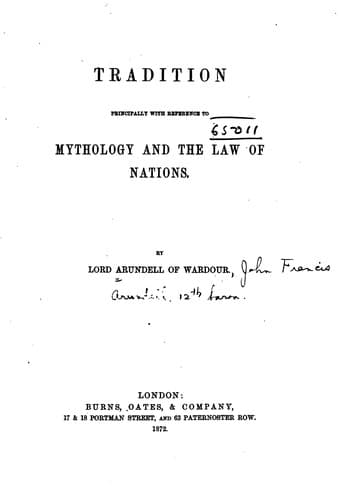
Tradition, Principally with Reference to Mythology and the Law of NationsArundell of Wardour, John Francis Arundell, Baron
Philosophy
Tradition, Principally with Reference to Mythology and the Law of Nations
Arundell of Wardour, John Francis Arundell, Baron
International law; Macdonell, George, 1780-1870; Mythology; Natural law; Tradition (Theology)
Now, in a certain modified sense, I should be quite prepared to
admit a stone age. Nothing more probable than that in the dispersion
certain families would have taken only what came readiest to hand.
Those who made long marches, and came to countries where minerals
were scarce, would have been in the way of losing the knowledge of
metals altogether, except in so far as they preserved the tradition
of them; and this would much depend upon how far they preserved other
traditions.[243] Some instance should be given us--and as there are
savages who are still using nothing but flint, there is still the
chance--of some set of savages who have spontaneously hit upon the
plan of fusing different metals, or even of smelting metals which
were under their eye? Certainly not our supposed flint ancestors,
who, as Professor Nillson and Sir J. Lubbock agree, must have got
their knowledge of bronze from Asia: Sir J. Lubbock inclining to an
Indo-European, Professor Nillson to a Phoenician "origin of the
bronze age civilisation." ("Pre-historic Times," p. 49.) All this
perfectly coincides with the view I have indicated, that the contrast
arose through the divergence of the lines of the dispersion, leading
the tribes to varied fortunes, some losing and others retaining the
tradition; and those who retained it eventually communicating it to
those who had lapsed. But then there are those unfortunate Bashkirs,
who, Professor Nillson tells us, are still in their stone age, and who
have remained Bashkirs since Herodotus described them as such 2300
years ago. As they have resisted the contact of civilisation so long,
one can only watch with careful curiosity the transitionary process by
which they will pass by internal development from their stone to their
bronze age.[244]
[243] "Mr Vaux of the British Museum has added the following
interesting note on the metallurgy of the ancients. 1st, The
earliest form of metal work appears to have been employed
in the ornamentation of sacred vessels for temples, &c....
Occasionally the floor or foundation of some temples was of
brass: thus [Greek: chalkeos oudos] (Soph. OEd. Col.),
perhaps like the room at Delphi called [Greek: laïnos oudos],
itself also a treasury."--Layard, "Nineveh and Babylon," p.
673.
Boulanger, "L'antiquité dévoilée par ses usage," (iii. 359),
says, "Ce sont les mystères qui out tiré les hommes de la vie
sauvage pour les ramener à la vie sociale et policée. Ces
mystères étoient un composé de cérémonies religieuses ...
_leur origine remonte_ au temps des héros et des demi-dieux."
[244] "Of all the different phases of civilisation, those which a
nation _must pass_ before it attains the highest grade of
development, the first rude state is the most enduring and the
most difficult to get over."--Professor Nillson's "Stone Age,"
191.
Public-domain text, read in full here on John Shaqi.
Reviews
Reviews
No reviews yet
Be the first to share your thoughts on this work.
Elsewhere in the archive
Join the Discussion
Join the discussion
Sign in to leave a comment or review.
Sign InorCreate an account