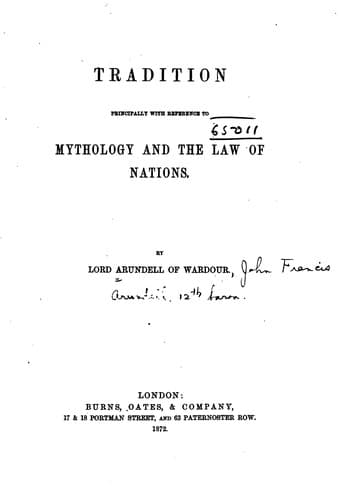
Tradition, Principally with Reference to Mythology and the Law of NationsArundell of Wardour, John Francis Arundell, Baron
Philosophy
Tradition, Principally with Reference to Mythology and the Law of Nations
Arundell of Wardour, John Francis Arundell, Baron
International law; Macdonell, George, 1780-1870; Mythology; Natural law; Tradition (Theology)
"The evidence of the transition from a stone to a bronze
age among the Egyptians _appears merely to be_ the use of
a stone knife found in their catacombs, and used for the
_sacred_ incision into the dead, although they used bronze and
iron knives for ordinary purposes, and whereas the _stone_
knife was used by the early _Hebrews_ in circumcision,
and by the priests of Montezuma as instruments of human
sacrifice."--Wilson's "Archæologia," p. 29.
I must now revert to what I at present wish to limit the discussion,
viz. Sir J. Lubbock's views on the subject of tradition.
Sir John says that history can throw no light upon the question of
the stone and bronze age, "because the use of metals has in all cases
preceded that of writing." I should like to know whether Sir John is
prepared to adhere to this "dictum" under all circumstances, inasmuch
as, if he does, he must allow me to trace the use of metals in Assyria
even beyond the date at which Professor Rawlinson seems actually to
have found evidence of their use; for (pp. 80, 198) "in the ruins
of Warka, the ancient Huruk or Erech" (the city of Nimrod) we find
inscriptions on bricks of the date of the reign of Urukh or Orchamus,
who, according to classical tradition, was the seventh in succession
from Bel or Nimrod; which tradition, says Rawlinson (p. 189), "accords
very curiously with the information derived from the inscriptions."
There is nothing to indicate that the bricks here discovered were
the first bricks ever _inscribed_; on the contrary, wherever we find
bricks and metals there will be a _prima facie_ presumption as to their
previous use.[245] Only upon Sir John Lubbock's "dictum," finding
evidence of writing at this date, we must necessarily conclude that
the use of metals preceded it. This would bring us well up the seven
reigns, and into close contact with the time of Nimrod.
[245] It amounts to this, that we are requested first of all to
discard and absolutely exclude all that we do know through
direct historical evidence of our origin, and to determine it
merely by scientific induction.
Sir J. Lubbock says in his introduction to Professor Nillson's
"Stone Age" (which is a summary of the whole question), "I
have purposely avoided all reference to history, all use of
historical data, because I have been _particularly anxious
to show_ that in archæology we can arrive at definite and
satisfactory conclusions, on independent grounds, without any
assistance from history; consequently regarding times before
writing was invented, and therefore before written history had
commenced" (p. xlii.) Compare with _supra_, ch. vii.
Public-domain text, read in full here on John Shaqi.
Reviews
Reviews
No reviews yet
Be the first to share your thoughts on this work.
Elsewhere in the archive
Join the Discussion
Join the discussion
Sign in to leave a comment or review.
Sign InorCreate an account