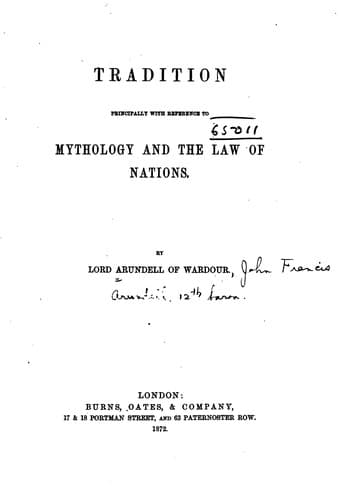
Tradition, Principally with Reference to Mythology and the Law of NationsArundell of Wardour, John Francis Arundell, Baron
Philosophy
Tradition, Principally with Reference to Mythology and the Law of Nations
Arundell of Wardour, John Francis Arundell, Baron
International law; Macdonell, George, 1780-1870; Mythology; Natural law; Tradition (Theology)
"Nor," says Sir J. Lubbock (p. 335), "will tradition supply the
place of history. At best it is untrustworthy and shortlived. Thus
in 1770 the New Zealanders had no recollection of Tasman's visit.
Yet this took place in 1643, less than one hundred and thirty
years before, and must have been to them an event of the greatest
possible importance and interest.... I do not mean to say that
tradition would never preserve for a long period the memory of any
remarkable event. The above-mentioned facts (De Soto's expedition
is also referred to) prove only that it will not always do so; but
it is unnecessary for us to discuss this question, as there is in
Europe no tradition of the Stone Age, and when arrow-heads are
found the ignorant peasantry refer them to the elves or fairies;
stone axes are regarded as thunderbolts, and are used not only in
Europe but also in various other parts of the world for magical
purposes" (p. 336).
_"Relieved" then_ "from _the embarrassing interference of
tradition_, the archæologist can only follow the methods which have
been so successfully pursued in geology" (p. 336).[246]
This is partly a limitation of the question to oral tradition, and
partly an anticipated denial of what I shall now venture to assert,
namely, that we can only look for the savages' traditions of things
known to them before they were savages, religious impressions which
have not been effaced from their minds, legends connected with
their race, facts which have determined their destiny. The very
characteristic of the savage is that he lives only for the present;
that he has little memory for the past, and no forecast for the future;
that his mind is stricken with a hopeless sterility and fixedness, so
that he only seems to remember things that are bred in the bone, and
the tradition of which he cannot divest himself.[247]
[246] "It must not be forgot to the honour of the Babylonians that
they are acknowledged, by all antiquity, to have been the
first who made use of writing in their public and judicial
acts, but at what period it is not known."--Goguet, "Origin of
Laws," i. 45.
Diodorus, however, says of the Egyptians (_vide_ p. 48),
"_Menes_ without doubt has been esteemed the first legislator
of Egypt, _because_ he was the first who put his _laws
in writing_. For before him Vulcan, Helius, and Osiris
(_vide ante_, p. 189) had given laws to
Egypt."--Diod. l. 1, 17-18.
But also it must be recollected that the copper mines of Egypt
were worked from the earliest period.
[247] But there are savages and savages; or rather there are savages
who are strictly such, and savages who have still the germ of
life and who are more properly distinguished as barbarians.
_Vide ante_, p. 285, De Maistre's definition of the
barbarian.
Public-domain text, read in full here on John Shaqi.
Reviews
Reviews
No reviews yet
Be the first to share your thoughts on this work.
Elsewhere in the archive
Join the Discussion
Join the discussion
Sign in to leave a comment or review.
Sign InorCreate an account