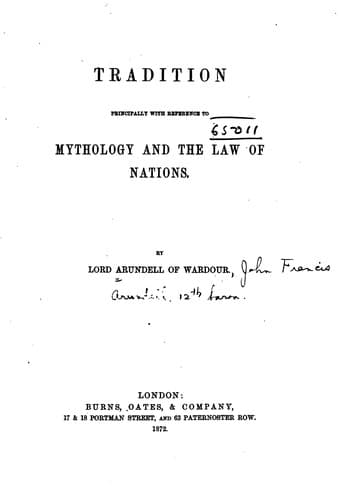
Tradition, Principally with Reference to Mythology and the Law of NationsArundell of Wardour, John Francis Arundell, Baron
Philosophy
Tradition, Principally with Reference to Mythology and the Law of Nations
Arundell of Wardour, John Francis Arundell, Baron
International law; Macdonell, George, 1780-1870; Mythology; Natural law; Tradition (Theology)
And so the ignorant peasantry when these flints were first dug up,
although they had "no tradition," rushed instinctively upon these
hatchets and considered them magical, apparently on no better grounds
than that they had belonged to a former race of men whom they
associated with elves and fairies. Was not this their way of saying
with Cicero, "Antiquitas proxime accedit ad deos."[248]
[248] I find curious testimony to the belief in M. Maupertius'
(Pinkerton, i. 252-4) account of an expedition of thirty
leagues which he was induced to make into the interior of
Lapland, by the accounts which he had received of a monument
which the Laplanders "looked upon as the wonder of their
country, and in which they conceived was _contained the
knowledge of everything_ of which they were ignorant." In
the end a monument was found bearing on it the appearance of
great antiquity, and an inscription which M. Celsius, his
companion ("very well acquainted with the Runic"), could
not read. M. Maupertius indeed says, "If the tradition of
the country be consulted, all the Laplanders assure us that
they are characters of great antiquity, containing valuable
secrets; but what can one believe in regard to antiquity from
those people who do not even know their own age, and who
for the greater part are ignorant who were their mothers."
Without supposing that the mysterious stone actually concealed
any valuable and recondite knowledge, I am still struck
by this attestation to the belief that antiquity shrouded
such secrets; and if, which does not altogether accord with
other accounts, the Lapps are as ignorant as they are here
represented, then it would seem to be true that when mankind
lose the knowledge of everything else, they still retain
the tradition of their loss and the knowledge of their
degradation. Concerning the superstitious veneration for stone
arrow-heads very generally diffused, _vide_ Mr E. T. Stevens'
"Flint Chips" (Salisbury, 1870, p. 89.)
And so far from tradition supplying us with no clue to solve the
problem of the stone age, does it not in this way suggest a very
decided though an antagonistic view to that of Sir John Lubbock.
The superstitious regard of the peasantry for these newly found
relics--which I presume came under Sir John's own observation when
exploring the northern coast-finds--is really very curious, because it
shows that their ideas and feelings in these matters were, after the
lapse of at any rate a thousand years, identical with those of their
ancestors. In evidence of which I adduce the following passage from
Professor Nillson, having reference to the legend of the "guse arrows"
or "Orvar Odd's saga":--
Public-domain text, read in full here on John Shaqi.
Reviews
Reviews
No reviews yet
Be the first to share your thoughts on this work.
Elsewhere in the archive
Join the Discussion
Join the discussion
Sign in to leave a comment or review.
Sign InorCreate an account