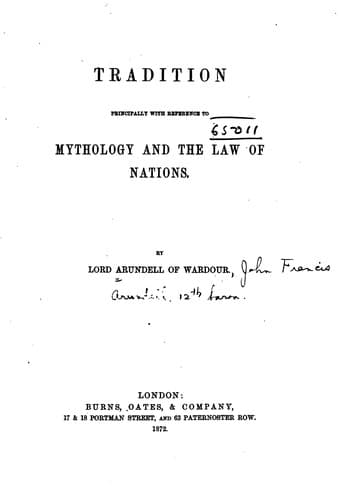
Tradition, Principally with Reference to Mythology and the Law of NationsArundell of Wardour, John Francis Arundell, Baron
Philosophy
Tradition, Principally with Reference to Mythology and the Law of Nations
Arundell of Wardour, John Francis Arundell, Baron
International law; Macdonell, George, 1780-1870; Mythology; Natural law; Tradition (Theology)
"This ancient romance shows very clearly that at the time when
it was composed, neither arrows, nor other weapons of stone were
in common use as weapons, but _that even then_ the opinion was
_generally current_ that these stone weapons, which owed their
existence to the dwarf race skilled in sorcery, were endowed with a
magic power against witches and witchcraft which no other weapons
possessed."--Professor Nillson, "Stone Age," p. 199.
But this suggests the further reflection, whether this stone age among
certain tribes was not as much in rejection as in ignorance of metals.
Professor Nillson (p. 97, 98) shows that flint was used for _sacred_
sacrificial purposes by the Jews, Egyptians, Phoenicians, and Latins,
long after they were acquainted with weapons of metal. Among these
the traditional idea about flint, whatever it was, was kept in due
subordination; but among tribes that had sunk into savagery it is
conceivable that it may have become a superstition, and dominated.
I am not sure that we do not underrate the capacity for tradition among
savages where it has once taken hold; still, if it had been a question
of mere savages, at the first glance I should have been disposed to
agree with Sir John Lubbock. But let us take the case of Tasman, which
Sir John puts forward as a sort of crucial case, and which may be
accepted as such, seeing that the New Zealanders may fairly claim to be
regarded as "barbarians."[249]
[249] _Vide_ Sir George Grey's "Polynesian Mythology," p. xiii.;
F. A. Weld's (Governor of Western Australia) "Notes on New
Zealand," pp. 15, 60.
In the first place, I find the following in a note to "Cook's Voyages"
(Smith, 1846):--"Mr Polack, in his 'Narrative of Travels and Adventures
during a residence in New Zealand between the years 1831-37,' collected
all the particulars relating to Cook's brush with the natives, 1769, on
the spot."
Next, let us see what Cook says on the subject of Tasman ("Cook's
Voyages," i. 164)--
"But the Indians still continued _near the ship_, rowing round many
times [hardly the most favourable conditions under which to recover
a tradition], conversing with Tupia [the Otaheitan interpreter]
chiefly concerning the traditions they had among them with respect
to the antiquities of their country. To this subject they were led
by the inquiries which Tupia had been directed to make, whether
they had ever seen such a vessel as ours, or had ever heard that
any such had been on their coast. These inquiries were all answered
in the negative, _so that_ tradition has preserved among them no
memorial of Tasman, though by an observation made this day we find
we are _only fifteen_ miles south of Murderers' Bay!"
Evidently the shrewd and gallant investigator himself was not satisfied
with the cross-examination, for we find at p. 170--
Public-domain text, read in full here on John Shaqi.
Reviews
Reviews
No reviews yet
Be the first to share your thoughts on this work.
Elsewhere in the archive
Join the Discussion
Join the discussion
Sign in to leave a comment or review.
Sign InorCreate an account