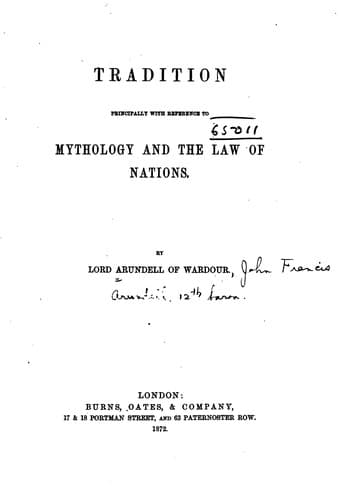
Tradition, Principally with Reference to Mythology and the Law of NationsArundell of Wardour, John Francis Arundell, Baron
Philosophy
Tradition, Principally with Reference to Mythology and the Law of Nations
Arundell of Wardour, John Francis Arundell, Baron
International law; Macdonell, George, 1780-1870; Mythology; Natural law; Tradition (Theology)
"When we were under sail one old man, Topaa [a native], came on
board to take leave of us; and as we were still desirous of making
further inquiries whether any memory of Tasman had been preserved
among their people, Tupia was directed to ask him whether he had
ever heard that such a vessel as ours had before visited the
country. To this he replied in the negative; but said that _his
ancestors had told him_ there had once come to this place a _small_
vessel from a distant country called Ulimaroa, in which were _four_
men, who upon coming on shore were _all killed_. Upon being asked
where this distant land lay he pointed to the northward."
But what does Tasman himself say?--
"On the 17th December these savages began to grow a little bolder
and more familiar, insomuch that at last they ventured on board
the _Heemskirk_, in order to trade with those in the vessel. As
soon as I perceived it, being apprehensive that they might attempt
to surprise that ship, _I sent my shallop_, with seven men, to
put the people in the _Heemskirk_ on their guard, and to direct
them not to place any confidence in these people. My seven men,
being _without arms_, were attacked by these savages, who _killed
three_ of the seven, and _forced_ the other _four_ to swim for
their lives; _which_ occasioned my giving that place the name of
the Bay of Murderers.[250] Our ship's company _would undoubtedly_
have taken a severe revenge if the rough weather had not prevented
them."--_Tasman's Voyage of Discovery, Pinkerton_, xi.
[250] This was a recognition on Tasman's part that there was a
violation of the law of nations, which he evidently considered
ought to have been recognised by these people. For killing
unarmed men he does not stigmatise them as savages, but
as murderers, which name has clung to the spot and to the
transaction to this day.
Now, I submit that this old man Topaa's recollection of the tradition
of an event which occurred one hundred and thirty years before his
time, was much more perfect than Captain Cook's, Sir Joseph Banks', Dr
Solander's, and Sir J. Lubbock's recollection of the same event from
geographical records.
Emboldened by this instance of the fallibility of scientific men, I
now proceed to question the truth of the two following propositions of
Sir J. Lubbock, after which I shall ask to be allowed to enunciate a
proposition of my own.
First, Sir J. Lubbock says: "It has been asserted over and over again
that there is no race of man so degraded as to be entirely without a
religion--without some idea of the Deity. So far from this being true,
the very reverse is the case" (p. 467).[251]
Public-domain text, read in full here on John Shaqi.
Reviews
Reviews
No reviews yet
Be the first to share your thoughts on this work.
Elsewhere in the archive
Join the Discussion
Join the discussion
Sign in to leave a comment or review.
Sign InorCreate an account