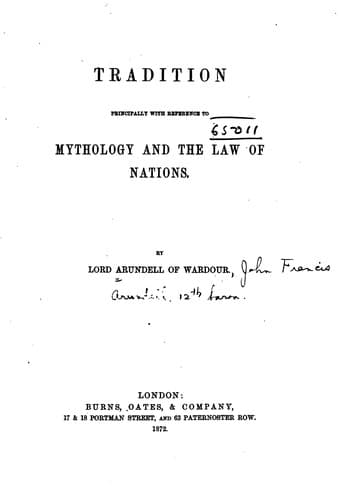
Tradition, Principally with Reference to Mythology and the Law of NationsArundell of Wardour, John Francis Arundell, Baron
Philosophy
Tradition, Principally with Reference to Mythology and the Law of Nations
Arundell of Wardour, John Francis Arundell, Baron
International law; Macdonell, George, 1780-1870; Mythology; Natural law; Tradition (Theology)
[251] I am aware that what I have opposed to Sir J. Lubbock is only
the contrary and not the contradictory of his proposition.
I find, however, that a very competent authority, Wilson,
"Archæology and Pre-historic Annals of Scotland," p. 42, says:
"No people, however rude or debased be their state, have yet
been met with so degraded to the level of the brutes as to
entertain no notion of a Supreme Being, or no anticipation
of a future state." "All polytheism is based on monotheism;
idolatry implies religious feeling."--_Bunsen's Egypt_, iv.
69. But in truth it was not a priest or a missionary who
first enunciated the contradictory of Sir John Lubbock's
proposition--it was Cicero. "Itaque ex tot generibus nullum
est animal, præter hominem, quod habeat notitiam aliquam dei:
ipsisque in hominibus nulla gens est, neque _tam immansueta_,
neque _tam fera_, quæ non _etiam si ignoret qualem habere deum
deceat_, tamen _habendum sciat_." De Legibus; i. 8.
Second, "It is a common opinion that savages are, as a general rule,
only the miserable remnants of nations once more civilised; but
although there are some well-established cases of national decay, there
is no scientific evidence which would justify us in asserting that this
is generally the case" (p. 337).
In opposition to the first proposition, I maintain that there is no
race of men so degraded as to be without some vestige of religion.
And in opposition to the second, I assert that if they have a vestige
of religion, and nothing else, they have still that which will convict
them of degeneracy.
First, To say that a savage has no idea of the Deity, is to say merely
that he is a savage; and it appears to me that this extinction of all
knowledge of the Deity among a people, precisely marks the point where
the barbarian lapses into the savage.
Taking the range of the authorities quoted by Sir J. Lubbock,[252]
I find a great concurrence of testimony to the fact that there is
some vestige of religion. One only--whose authority on any other
point incidental to African travel I should regard as of the highest
value--Captain Richard Burton, asserts without qualification, and in
language sufficiently explicit, that "some of the tribes of the lake
district of Central Africa admit neither God, nor angel, nor devil."
Others assert the same negatively--they did not come upon any signs of
religion, any external observances, any trace of ceremonial worship.
For instance, it is said that the Tasmanians had no word for a Creator
(p. 468, Lubbock), which need not excite surprise, as it is also said
of them that they were incapable of forming any abstract ideas at all
(p. 355, Lubbock). Again, in many of those cases where it is more or
less roundly asserted that there is no vestige of religion, we find it
plainly intimated that there is a belief in the devil, _e.g._ Lubbock,
p. 469.
Public-domain text, read in full here on John Shaqi.
Reviews
Reviews
No reviews yet
Be the first to share your thoughts on this work.
Elsewhere in the archive
Join the Discussion
Join the discussion
Sign in to leave a comment or review.
Sign InorCreate an account