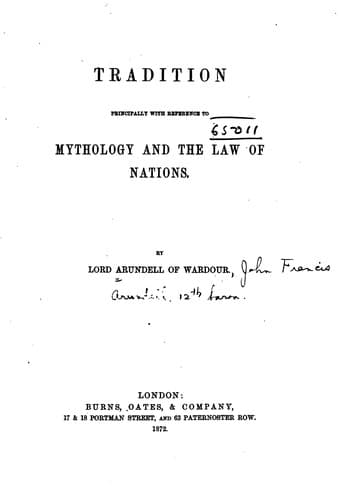
Tradition, Principally with Reference to Mythology and the Law of NationsArundell of Wardour, John Francis Arundell, Baron
Philosophy
Tradition, Principally with Reference to Mythology and the Law of Nations
Arundell of Wardour, John Francis Arundell, Baron
International law; Macdonell, George, 1780-1870; Mythology; Natural law; Tradition (Theology)
[252] I should not have considered it necessary to have entered so
elaborately into this argument, if I had previously read the
chapter on Animism in Mr Tylor's "Primitive Culture." The
instances, however, which follow will stand as supplementary.
"The Tonpinambas of Brazil had _no religion_, though if the name is
applied 'à des notions fantastiques d'êtres surnaturals et puissans
on ne sauroit nier qu'ils n'eussent une croyance religieuse et
_même une sorte_ de culte exterieur.'"--_Freycinet_, i. 153.
Now, although the devil may, and in many instances no doubt has,[253]
made a special revelation of himself to his votaries, the ordinary
channel of information concerning him is through tradition, and through
the tradition of the fall of man.
[253] Sir J. Lubbock says (p. 370) of the Feegee islanders: "They
did not worship idols, but many of the priests seem to have
really thought that they had been in actual communication with
the Atona; and some of the early missionaries were inclined
to believe that Satan may have been permitted to practise a
deception upon them, in order to strengthen his power. However
extraordinary this may appear, the same was the case in
Tahiti."
But I ask further of those who dispute this, If savages are found with
this fear of the supernatural world, after they have lost the idea of
God, how do they get it? If not from tradition, then from reflection?
But savages do not reason (Lubbock, p. 465). Moreover, at p. 470, Sir
J. Lubbock says, what really brings us very nearly to agreement, "How,
for instance, can a people who are unable to count their own fingers,
possibly raise their minds so far as to admit even the rudiments of
a religion?" This is said with reference to a previous allegation,
"That those who assert that even the lowest savages believe in a
Deity, affirm that which is entirely contrary to the evidence" (p.
470). But there is a great concurrence of evidence that "even the
lowest savages" believe in the devil. Belief in the devil involves a
realisation more or less obscure of the fallen angel, of the Spirit
of Evil--and this for the savage who "cannot count his fingers" is
as great an intellectual effort as would be, merely considered as an
intellectual effort, a belief in the Deity. On any theory of growth or
development how could he ("the lowest savage") have got the idea?
Public-domain text, read in full here on John Shaqi.
Reviews
Reviews
No reviews yet
Be the first to share your thoughts on this work.
Elsewhere in the archive
Join the Discussion
Join the discussion
Sign in to leave a comment or review.
Sign InorCreate an account