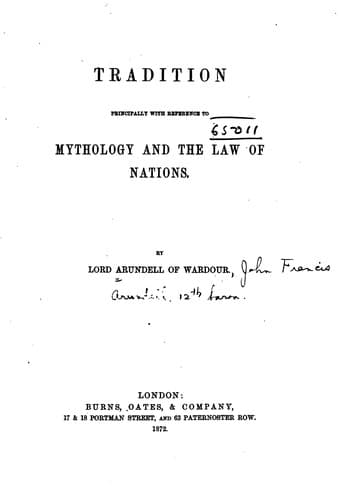
Tradition, Principally with Reference to Mythology and the Law of NationsArundell of Wardour, John Francis Arundell, Baron
Philosophy
Tradition, Principally with Reference to Mythology and the Law of Nations
Arundell of Wardour, John Francis Arundell, Baron
International law; Macdonell, George, 1780-1870; Mythology; Natural law; Tradition (Theology)
Several writers who are quoted, whilst they deny the existence of any
notion of religion among a particular people, mention facts which are
incompatible with that statement. I may also say, parenthetically, that
to detect or elicit the sentiment of religion in others, one must have
something of the sentiment in ourselves; _e.g._ there is the instance
of Kolben (Lubbock, p. 469), "who, _in spite_ of the assertions of the
natives themselves, _felt quite sure_ that certain dances _must be_ of
a religious character, let the Hottentots say what they will." Now I
must say there is great _à priori_ probability in the truth of Kolben's
conviction, although he was probably led to it merely by the insight of
his own mind. Let it be taken in connection with the following evidence
in Washington Irving's "Life of Columbus," iii. 122-124:--
"The _dances_ to which the natives seemed so immoderately addicted,
and which had been _at first_ considered by the Spaniards mere
idle pastimes, were _found_ to be often _ceremonials of a serious
and mystic character_." Again--"Peter Martyn observes that they
performed these dances to the chant of certain metres and ballads
_handed down from_ generation to generation, in which were
rehearsed the deeds of their ancestors. Some of these ballads were
of a _sacred_ character, containing their _traditional_ notions of
theology, and the superstitions and fables which comprised their
religious creeds."
Pritchard, "Researches into Phys. Hist. of Man" (i. p. 205), quoting
Oldendorp, and speaking of the African negroes, says:--"At the annual
harvest feast, which _nearly all_ the nations of Guinea solemnise,
thank-offerings are brought to the Deity. These festivals are days of
rejoicing, which the negroes pass with feasting and dancing." _Vide_
also "Hist. of Indian Tribes of North America, 120 portraits from the
Ind. Gal. in Depart. of War at Washington, by T. M'Kenney (late Ind.
Dep. Wash.) and J. Hall of Cincinnati" (Philadelphia, 1837).
"Dancing is among the most prominent of the aboriginal
_ceremonies_; there is no tribe in which it is not practised. The
Indians have their _war_ dance and their _peace_ dance, their dance
of _mourning for the dead_, their _begging_ dance, their pipe
dance, their green-corn dance, and their Wabana (an offering to
the devil). Each of these is distinguished by some peculiarity ...
though to a stranger they appear much alike, except the last....
It is a ceremony and not a recreation, and is conducted with a
seriousness belonging to an important public duty."
Public-domain text, read in full here on John Shaqi.
Reviews
Reviews
No reviews yet
Be the first to share your thoughts on this work.
Elsewhere in the archive
Join the Discussion
Join the discussion
Sign in to leave a comment or review.
Sign InorCreate an account