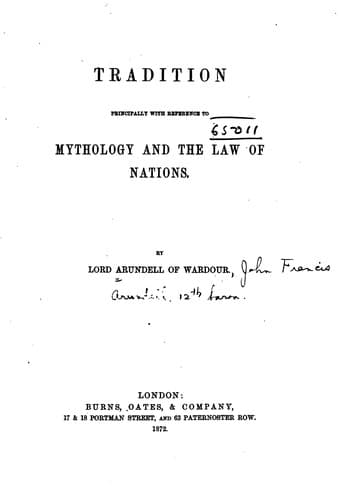
Tradition, Principally with Reference to Mythology and the Law of NationsArundell of Wardour, John Francis Arundell, Baron
Philosophy
Tradition, Principally with Reference to Mythology and the Law of Nations
Arundell of Wardour, John Francis Arundell, Baron
International law; Macdonell, George, 1780-1870; Mythology; Natural law; Tradition (Theology)
At p. 437 (Lubbock) it is said, "Admiral Fitzroy never witnessed
or heard of any act of a decidedly religious character among the
Fuegians." Still, as Sir John admits, "some of the natives suppose
that there is a great black man in the woods who knows everything, and
cannot be escaped." If this is not the devil, it looks very like him.
Again, p. 469, Mr Mathews says, speaking of the Fuegians, "he sometimes
heard a great howling or lamentation about _sunrise_ in the morning;
and upon asking Jemmy Button what occasioned the outcry, he could
obtain no satisfactory answer; the boy only saying, 'people very sad,
cry very much.'" Upon which Sir John remarks, "This appears so natural
and sufficient an explanation, that why the outcry should be 'supposed
to be devotional' I must confess myself unable to see" (469).
Now, if this was not their traditional notion and mode of prayer,
degraded according to the measure of their degeneracy, the degeneracy
is at least proved in another way, for, being still reasonable beings,
they had, according to the account, congregated together to send up
a lamentation, which, if it was not prayer, could be likened only to
the moonlight howling of wolves. This mode of prayer resembles what
Father Loyer and the missionary Oldendorp (Pritchard, i. 197) tells
us of the negroes. Father Loyer "declares that they have a belief in
a universally powerful Being, and to him they address prayers. Every
morning after _they rise_ they go to the river side to wash, and
throwing a handful of water on their head, or pouring sand with it
to express their humility, they join their hands and then open them,
whisper softly the word 'exsuvais.'" Oldendorp says (p. 202): "The
negroes profess their dependence on the Deity, ... they pray _at the
rising_ and setting of the sun,[254] on eating and drinking, and when
they go to war." Compare also Helps' "Spanish Conquest in America," i.
285:--
"The worship of the Peruvians was not the mere worship of the
sun alone as of the most beautiful and powerful thing which they
beheld; but they had _also_ a worship of a far more elevated and
refined nature, addressed to Pachacamac, the soul of the universe,
_whom_ they hardly dared to name; and when they were obliged to
name this Being, they did so inclining the head and the whole body,
now _lifting_ up the eyes to heaven, now lowering them to the
ground, and _giving kisses in the air_. To Pachacamac they made
no temple and offered no sacrifices, but they adored him in their
hearts."[255]
[254] After all, is there not something in their mode of prayer
which recalls the language of Psalm cxl., "Dirigatur oratio
mea sicut incensum in conspectu tuo: _elevatio manuum mearum
sacrificium vespertinum_."
Public-domain text, read in full here on John Shaqi.
Reviews
Reviews
No reviews yet
Be the first to share your thoughts on this work.
Elsewhere in the archive
Join the Discussion
Join the discussion
Sign in to leave a comment or review.
Sign InorCreate an account