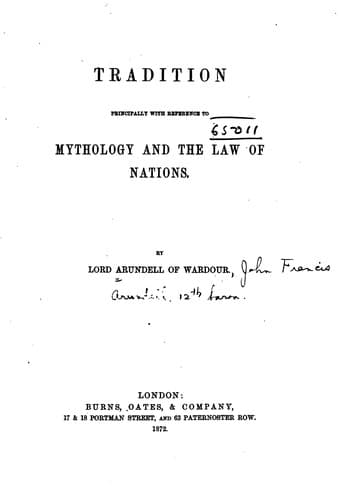
Tradition, Principally with Reference to Mythology and the Law of NationsArundell of Wardour, John Francis Arundell, Baron
Philosophy
Tradition, Principally with Reference to Mythology and the Law of Nations
Arundell of Wardour, John Francis Arundell, Baron
International law; Macdonell, George, 1780-1870; Mythology; Natural law; Tradition (Theology)
If the reader will refer to Bunsen's "Egypt," &c. vol. i.
p. 497, he will find "a man with uplifted arms" as the
ideographic sign (19) for "to praise, glorification," which
is in evidence not only that it was the natural but the
traditional mode.
[255] Garcilasso de la Vega's authority is so unimpeachable, and at
the same time his testimony is so unmistakable on this point,
that it will be as well to give his own words, as he was well
acquainted with the Peruvian traditions, through his mother,
who was one of the Yncas. He adds: "When the Indians were
asked who Pachacamac was, they replied that he it was who gave
life to the universe, and supported it; but that they knew him
not, for they had never _seen_ him, and that for this reason
they did not build temples to him, nor offer him sacrifices;
but that they worshipped him in their hearts (mentally),
and considered him to be an _unknown God_.... From this it
is clear, that these Indians considered him to be the maker
of all things." Hakluyt ed. of Garcil. de la Vega's "Royal
Commentaries of the Yncas," ed. C. Markham, 1869, i. 107. He
further remarks that, whereas they hesitated to pronounce the
name of Pachacamac, "they spoke of the sun on every occasion."
Compare the accounts we have of the Guanches. M. Pegot Ogier,
"The Fortunate Isles" (Canaries), 1871, says (p. 283), that
a comparison of the Chronicles of the Conquest shows that,
"far from being idolaters, the Guanches worshipped one God,
the Creator and Preserver of the world," and that (p. 282),
"in their worship, they _raised their hands_ to heaven, and
sacrificed on the mountains by pouring milk on the ground
from a _height_; their milk was carried in a sacred vase
called _ganigo_." The name of their god, "Achoron Achaman"
= "He who upholds the heaven and earth," and "Achuhuyahan
Achuhucanac" = "He who sustains every one," has resemblances
with "Pachacamac" = "Pacha," the earth; and "camac" participle
of "camani," "I create."--(C. Markham, Hakluyt ed. of Garcil.
de la Vega, i. 101.)
At p. 468 Sir John somewhat too roundly asserts that "Dr Hooker tells
us that the Lepchas of Northern India have _no religion_."
Public-domain text, read in full here on John Shaqi.
Reviews
Reviews
No reviews yet
Be the first to share your thoughts on this work.
Elsewhere in the archive
Join the Discussion
Join the discussion
Sign in to leave a comment or review.
Sign InorCreate an account