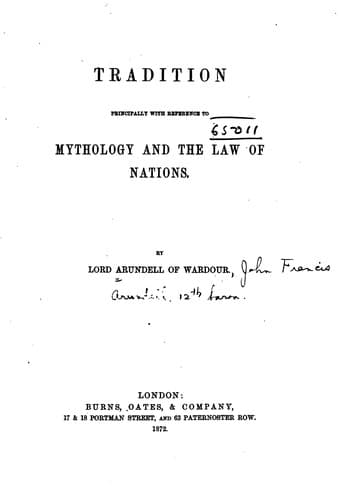
Tradition, Principally with Reference to Mythology and the Law of NationsArundell of Wardour, John Francis Arundell, Baron
Philosophy
Tradition, Principally with Reference to Mythology and the Law of Nations
Arundell of Wardour, John Francis Arundell, Baron
International law; Macdonell, George, 1780-1870; Mythology; Natural law; Tradition (Theology)
Turning to Dr Hooker's "Himalayan Journal," I find (i. 135), "The
Lepchas profess no religion, _though_ acknowledging the existence of
good and bad spirits.... Both Lepchas and Limboos _had, before the_
introduction of Lama Boodhism from Tibet, many features in common with
the natives of Arracan, especially in _their creed_, _sacrifices_,
faith in omens, worship of many spirits, absence of idols, and of the
doctrine of metempsychosis" (p. 140). We have already seen (_supra_, p.
224) that they had a very distinct tradition of the Deluge; indeed
there is much in the account of them which reminds us of the primitive
monotheism.
So, too, Sir John asserts, p. 469, "Once more Dr Hooker states that
the Khasias, an Indian tribe, _had no religion_. Col. Yule, on the
contrary, says that they have, but he admits that breaking hens' eggs
is the principal part of their religious practice."
It is true that Dr Hooker says (ii. 276), "The Khasias are
superstitious, but have no religion;" he adds, however, "_like the
Lepchas, they believe in a Supreme Being_, and in deities of the
grove, cave, and stream." It seems, however, that the only outward
manifestation of their religion is in "breaking hens' eggs"! What
can be more ludicrous! yet here, too, would seem to be a vestige of
primitive tradition. We know (_vide_ Wilkinson, "Ancient Egyptians,"
second series) how primitive truth was concealed under material
symbols. Gainet (i. 127) also says, "Even upon the hypothesis that
these fragments of the Egyptian cosmogony were lost, one of the
hieroglyphics which this people has left us would suffice to convince
us of their belief in a Creator. It is the image of the god Kneph,
whom they represent with _an egg_ in his mouth; _this egg_ being the
natural image of the world taking its birth from this divinity." Again,
p. 115, "In the mysteries of Bacchus[256] the dogma of the Creation
was proposed under the emblem of that celebrated _egg_, of which the
poets have so often spoken, which contained the germ of all things."
"_The egg_," says Plutarch, "is consecrated to the sacred ceremonies of
Bacchus, as a representation of the Author of nature who produces and
comprehends all things in himself." There is a passage in Athenagoras
to the same effect.
[256] Compare with pp. 156, 214.
Public-domain text, read in full here on John Shaqi.
Reviews
Reviews
No reviews yet
Be the first to share your thoughts on this work.
Elsewhere in the archive
Join the Discussion
Join the discussion
Sign in to leave a comment or review.
Sign InorCreate an account