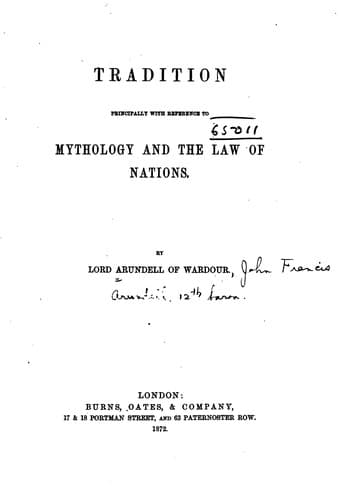
Tradition, Principally with Reference to Mythology and the Law of NationsArundell of Wardour, John Francis Arundell, Baron
Philosophy
Tradition, Principally with Reference to Mythology and the Law of Nations
Arundell of Wardour, John Francis Arundell, Baron
International law; Macdonell, George, 1780-1870; Mythology; Natural law; Tradition (Theology)
At the same time, I do not disguise from myself that, in its present
mood, the world is much more anxious to be cut adrift from tradition
than to be held to its moorings; and that it will impatiently learn
that fresh facts have to be considered before its emancipation can be
declared, or before it can be let loose without the evident certainty
of shipwreck. Although the exigencies of the argument have compelled
research over a somewhat extended field of inquiry, the exploration
has no pretensions to being exhaustive, but at most suggestive; not
attempting to work the mine, or, except incidentally, to produce the
ore, but only indicating the positions in which it is likely to be
found.
In the main position of the mythological chapters, that the heroes of
mythological legend embody the reminiscences of the characters and
incidents of the biblical narrative, I do nothing more than carry on a
tradition, as the reader will see in my references to Calmet, Bryant,
Palmer, and others.[1] I should add, that I limit the full application
of De Maistre's theory to the times preceding the coming of our Lord.
[1] It has curiously happened that I have never seen the work
which, after Bryant, would probably have afforded the largest
repertory of facts--G. Stanley Faber's "Dissertation on the
Mysteries of the Cabiri;" and it is only recently, since
these pages were in print, that I have become acquainted with
Davies' "Celtic Researches" and "The Mythology and Rites of
the British Druids." The Celtic traditions respecting their
god Hu, are so important from more than one point of view,
that I cannot forbear making the following extracts from the
latter author, which I trust the reader will refer back to and
compare in chap. ix. with the Babylonian Hoa, at p. 66 with
the Chinese Yu, and at p. 262 with the African Hu.
Public-domain text, read in full here on John Shaqi.
Reviews
Reviews
No reviews yet
Be the first to share your thoughts on this work.
Join the Discussion
Join the discussion
Sign in to leave a comment or review.
Sign InorCreate an account